Complex numbers may appear a difficult subject given the name. However, there is nothing of really complicated about complex numbers. However, they definitively add a pinch of \em magic \em in the mathematics manipulations that you can do with them!
Continue readingScience Topics
Berechnung der Konstante von Madelung
Die gesamte Coulomb-Potentialenergie eines Kristalls ist die Summe der einzelnen Terme der elektrostatischen Potentialenergie
zum Laden von Ionen e
und getrennt nach Entfernung
.
Die Summe erstreckt sich auf alle im Festkörper vorhandenen Ionenpaare für alle kristallinen Strukturen.
Die Summe konvergiert sehr langsam, weil die ersten Nachbarn des Zentralatoms einen substanziellen Beitrag zur Summe mit einem negativen Term liefern, während die benachbarten Sekunden nur mit einem etwas weicheren positiven Term beitragen, und so weiter. Auf diese Weise wird der Gesamteffekt sicherstellen, dass eine totale Initation der Anziehung zwischen Kationen und Anionen vorherrscht mit einem (negativen) Beitrag, der für die Gesamtenergie günstig ist.
Continue readingCalculus in a Nutshell: Functions and their Derivatives
When I was about thirteen, the library was going to get ‘Calculus for the Practical Man.’ By this time I knew, from reading the encyclopedia, that calculus was an important and interesting subject, and I ought to learn it.
Richard P. Feynman, from What Do You Care What Other People Think?
Introduction
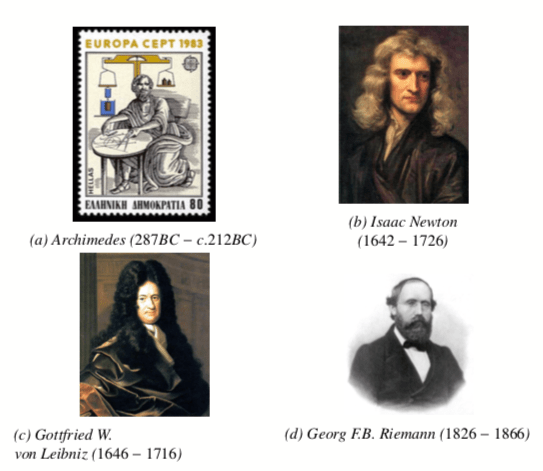
Calculus is an important branch of mathematics that deals with the methods for calculating derivatives and integrals of functions and using this information to study the properties of functions. It was independently invented by I. Newton and W. Leibniz in the 18 century and it was further developed by other great mathematicians in the centuries that follows (see Figure below).
It comprises two areas:
- Differential calculus
It concerns the study of the rate of variation of functions.
- Integral calculus
It concern the study of the area under functions.
Depending on the nature of the functions involved in the calculations, we can further distinguish between the single- and multi-variable calculus. In this chapter, the main concepts and methods of the single-variable calculus are summarised.
Continue readingThe Fourier Transform
Pure mathematics is much more than an armory of tools and techniques for the applied mathematician. On the other hand, the pure mathematician has ever been grateful to applied mathematics for stimulus and inspiration. From the vibrations of the violin string they have drawn enchanting harmonies of Fourier Series, and to study the triode valve they have invented a whole theory of non-linear oscillations.
George Frederick James Temple In 100 Years of Mathematics: a Personal Viewpoint (1981).
The Fourier Transform (FT) is an integral transform, a powerful mathematical tool to map a function from its original space representation into another function space (called, in this case, the Fourier space). In the time domain, the Fourier space is the frequency and in the Cartesian domain is the so-called reciprocal space. The FT is accomplished by integrating the given function in its original space. The advantage of the FT is that in the transformed space, the properties of the original function can usually be characterised and manipulated more quickly than in the original function space. The FT function can generally be mapped back to the original function space using the inverse FT.
The FT plays an important role in pure and applied science, computer science, electronic engineering, and medicine. In this lecture, I will shortly introduce the mathematics of the FT and then show some examples of practical applications.
Continue readingThe Fourier Series
Pure mathematics is much more than an armory of tools and techniques for the applied mathematician. On the other hand, the pure mathematician has ever been grateful to applied mathematics for stimulus and inspiration. From the vibrations of the violin string they have drawn enchanting harmonies of Fourier Series, and to study the triode valve they have invented a whole theory of non-linear oscillations.
George Frederick James Temple In 100 Years of Mathematics: a Personal Viewpoint (1981).

The Fourier Series is a very important mathematics tool discovered by Jean-Baptiste Joseph Fourier in the 18th century. The Fourier series is used in many important areas of science and engineering. They are used to give an analytical approximate description of complex periodic function or series of data. In this blog, I am going to give a short introduction to it.
Continue readingNote di Meccanica Classica
In questo blog vengono derivate alcune equazioni fondamentali della meccanica classica che sono anche alla base del metodo della simulazione di Dinamica Molecolare.
Continue readingLa Serie di Taylor
La serie di Taylor è un utilissimo strumento matematico. In questo blog, ne darò una breve descrizione dando qualche esempio di applicazione.
Chi è il signor Taylor?
Brook Taylor (1685 – 1731) era un matematico britannico del XVII secolo che ha dimostrato la formula che porta il suo nome, e l’argomento di questo blog, nel volume Methodus Incrementorum Directa et Inversa (1715). Maggiori informazioni si possono trovare nella corrispondente pagina della wikipedia.
Continue readingPlatonic Solid and Chemistry: the Icosahedral Boron Clusters
Boron is the fifth element in the periodic table. It is also the first element of the boron group or the group thirteenth of the periodic table. It is a metalloid element, meaning its properties are between a metal and a nonmetal. The chemical symbol for boron is B, which has an atomic weight of 10.81 grams per mole.

In its ground state, a boron atom contains five electrons arranged in two energy levels. The first energy level, or shell, can hold up to two electrons, while the second can hold up to eight. However, boron has three valence electrons, meaning only the first two energy levels are filled, leaving the third energy level partially empty.
Continue readingThe Taylor Series
The Taylor series is a mathematical tool that, sometimes, it is not easy to immediately grasp by freshman students. In this blog, I will give a short review of it giving some examples of applications.
Who is Mr. Taylor?
Brook Taylor (1685 – 1731) was a 17th-century British mathematician. He demonstrated the celebrated Taylor formula, the topics of this blog, in his masterwork Methodus Incrementorum Directa et Inversa (1715). For more information, just give a read to the following wiki page.
Continue readingModelling Natural Pattens and Forms I: Sunflowers Florets and the Golden Ratio
Continue readingIl girasole piega a occidente
e già precipita il giorno nel suo
occhio in rovina …
from the poem “Quasi un madrigale” by Salvatore Quasimodo.