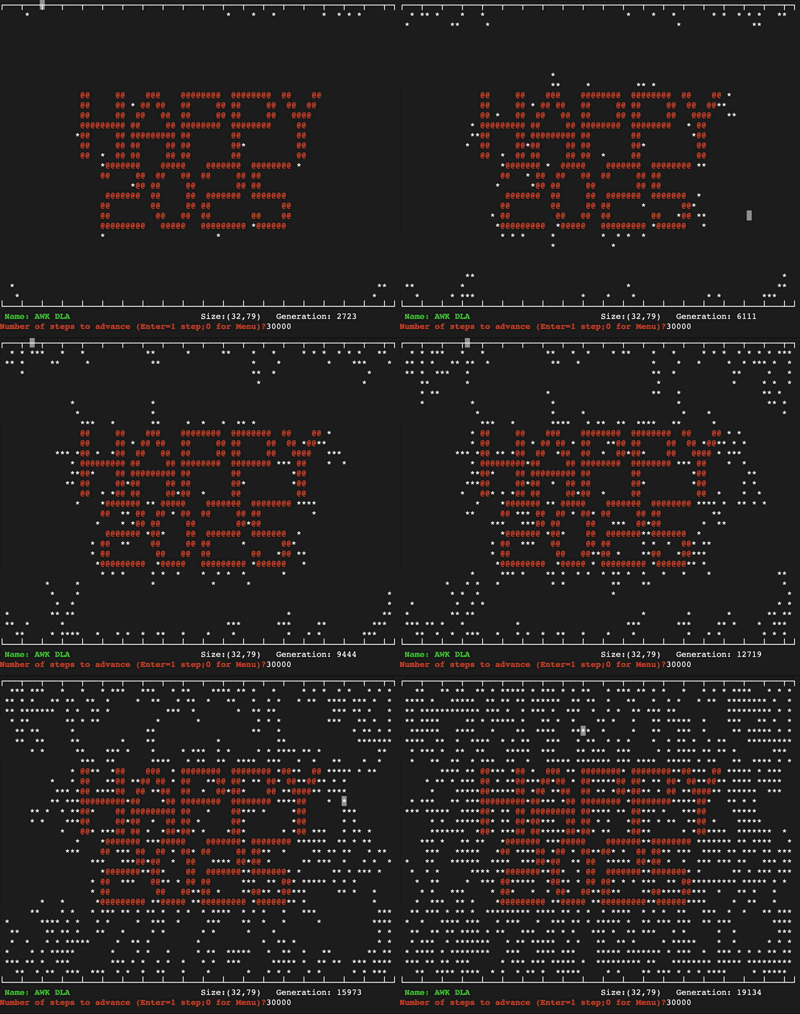
Christmas 2025: Growing Christmas Trees from Factorials

Christmas is a time for traditions, decorations, and—at least for some of us—quiet moments spent playing with ideas. In that spirit, this post is a small seasonal diversion: a recreational exploration of large factorial numbers, their historical computation, and an unusual way to see them. The inspiration comes from an old but delightful article by the great recreational mathematician  Martin Gardner, titled “In which a computer prints out mammoth polygonal factorials” (Scientific American, August 1967), in which he discusses the astonishing growth of the function

n! = 1 \cdot 2 \cdot 3 \cdots n

and the surprising difficulty computers once faced when trying to compute it for even modest values of n.

In this post, I will briefly describe the Smith bin algorithm for computing large factorials and present the result for the number 2025, arranged in a geometric form. After all, if numbers are going to grow explosively, why not let them grow into Christmas trees for 2025?

Continue reading

Principal Component Analysis: Key to Analyzing Biomolecular Dynamics

I have recently written, for WIREs Computational Molecular Science, a review article on the use of Principal Component Analysis (PCA) in the study of dynamical systems, with a particular focus on molecular dynamics (MD) simulations of biomolecules [1]. The aim of this work is to provide a clear and practical overview of how PCA has become a central tool for extracting meaningful collective motions from high-dimensional simulation data, and how modern methodological extensions continue to expand its capabilities.

Continue reading

RaPenduLa: Una Video piattaforma Fai-Da-Te Per Studiare Oscillazioni Meccaniche

Qualche giorno fa ho pubblicato un nuovo progetto educativo sul mio sito Instructables. Il dispositivo, che ho battezzato RaPenduLa (dalle iniziali in inglese di RaspPi Pendulum Laboratory), è stato ribattezzato in italiano CAMPO (Computer Analisi Moto Pendolare Oscillante) grazie a un suggerimento di ChatGPT. Ma, come direbbe Shakespeare, ‘What’s in a name? That which we call a rose by any other name would smell as sweet’: il cuore del progetto è infatti una piattaforma video per lo studio delle oscillazioni meccaniche. Utilizzando un Raspberry Pi Zero W2 dotato di modulo fotocamera, il sistema registra ad alta velocità il movimento dei pendoli. Poi, con un’analisi video basata su Python e OpenCV, RaPenduLa è in grado di tracciare il percorso preciso della punta del pendolo, visualizzandone il comportamento oscillatorio in 2D.

Continue reading

Easter 2025: Exploring Egg-Shaped Billiards

It has become a recurrent habit for me to write a blog on the shape of eggs to wish you a Happy Easter. Not repeating oneself and finding a new interesting topic is a brainstorming exercise of lateral thinking and a systematic search in literature to find an interesting connection. This year, I wanted to explore an idea that has been lurching in my mind for some time for other reasons: billiards.

I used to play snooker from time to time with some old friends. I am a far cry from being even an amateur in the billiard games, but I had a lot of fun verifying the laws of mechanics on a green table. I soon discovered that studying the dynamics of bouncing collision of an ideal cue ball in billiards of different shapes keeps brilliant mathematicians and physicists engaged in recreational academic studies and important theoretical implications.

Continue reading

I received a surprise gift, and I want to express my gratitude for your support!

Today, I was pleasantly surprised by a message from WordPress. It announced that a very generous reader had gifted a subscription. This gift covers the cost of my personal plan and website domain.

First and foremost, I want to express my heartfelt thanks to this undisclosed reader for their generosity. You are the first to make such a donation. Your support has given me a great boost of encouragement to continue writing. If you wish, I would be happy to acknowledge you on this page.

This blog began as a personal space to share my work as an educator and scientist. Over time, it has also become a place for reflections on my past experiences and long-standing hobbies. I enjoy exploring a wide range of scientific topics that spark my curiosity, and I write simply for the joy of sharing my enthusiasm for science. My endless curiosity drives my fascination with the natural world and the universe around us. I started this journey with no particular expectations—just personal fulfillment. Now, I’m delighted to see the readership growing and grateful that some of you find this blog valuable enough to support it.

I have written this post in English. I do not know the donor’s primary language. This ensures my gratitude reaches you. If English is not your main language, inform me. I am happy to express my thanks in Italian or German.
Spero tuttavia che il mio messaggio sia chiaro anche ai tanti connazionali che leggono le mie pagine in italiano o ai lettori di lingue latine che possono comprenderlo, e li ringrazio di cuore.

Und ich hoffe auch, dass viele deutschsprachige Leser meine Seiten auf Deutsch verstehen können – so gut es geht! 😊

RaPenduLa: A DIY Video Platform for Exploring Mechanical Oscillations

I have recently published another educational project on my Instructables website. I called the device RaPenduLa for the RaspPi Pendulum Laboratory, and it is a video platform for studying mechanical oscillations. It uses a Raspberry Pi Zero W2 equipped with a camera module to record the motion of pendulums at high speed. The interesting part happens through video analysis: using Python and the fantastic OpenCV library, RaPenduLa can track the precise path of a pendulum’s tip and help visualize its oscillatory behavior in two dimensions.

Continue reading

A Virtual Microscope for Nanoscience

I am pleased to announce the publication of the second edition of my book chapter: “A Short Introduction to the Molecular Dynamics Simulation of Nanomaterials” [1] in Micro and Nanomanufacturing, Volume II, edited by W. Ahmed and M. J. Jackson, Springer, 2025. This new edition reflects both the rapid evolution of molecular dynamics (MD) simulations over the past decade and their growing role in nanoscience.

Molecular dynamics simulations have become a cornerstone of modern nanoscience. They allow us to observe matter at the atomic scale, following the motion of thousands—or millions—of atoms in time, effectively turning the computer into a virtual microscope. From nanoparticles and nanotubes to polymers, membranes, and bio–nano interfaces, MD simulations provide insights that are often inaccessible to experiments alone. They help us understand:

  • Structural organization at the nanoscale
  • Dynamic processes such as adsorption, diffusion, and self-assembly
  • Thermodynamic and mechanical properties relevant to material design

This chapter is written with the explicit goal of making these ideas accessible, without sacrificing physical rigor.

Continue reading

Season’s Greetings with Diffusion-Limited Aggregation!


As the year comes to a close, let us take a moment to reflect on the beauty of nature and the profound patterns that can arise from simple rules. Inspired by the Diffusion-Limited Aggregation (DLA) simulation—a concept that creates mesmerizing structures from chaotic randomness—we find parallels between its patterns and the essence of the holiday season.

The animation featured here was created using my DLA simulator, written in Awk, my favorite programming language. This program simulates the deposition of randomly diffusing particles in two dimensions. In this case, it mimics the formation of snowflakes or coriander-like clusters, with particles meandering through randomness to form intricate fractal structures.

These patterns remind us how small, individual efforts can come together to create something extraordinary. Be it family gatherings, acts of kindness, or moments of generosity, each step contributes to a larger, beautiful picture—much like how particles aggregate to form stunning natural structures such as snowflakes, coral reefs, or mineral deposits.

Wishing You:

🎄 Fractal Joy: Let your happiness grow in beautiful and unexpected ways.

🌟 Boundless Creativity: Like the Moore and von Neumann neighborhoods in the simulation, embrace different perspectives to expand your horizons.

❄️ Peace and Harmony: May your life’s matrix be filled with meaningful connections and serene moments.

May your holidays be filled with love, joy, and wonder — and may your 2024 be as inspiring as the intricate patterns of life itself!

Happy Holidays! 🌟

RasMol: A Classic Tool for Molecular Visualization

In questo articolo descrivo come ho usato per molti anni il programma di visualizzazione molecolare Rasmol per delle esercitazioni pratiche di chimica generale presso l’Università dell’Aquila (Italia). Le esercitazioni consistevano nella visualizzazione di strutture cristallografiche di sistemi molecolari e nella misura di alcune proprietà geometriche. Per questo scopo è stato usato Rasmol controllato da un’interfaccia, scritta nel linguaggio Tcl/Tk, che permetteva di selezionare la struttura molecolare da visualizzare.

RasMol è uno tra i programmi più diffusi per la visualizzazione di strutture molecolari. Esso è liberamente distribuito e nel sito web (http://www.rasmol.org) è possibile ottenere il codice sorgente e gli eseguibili per i sistemi operativi Linux, MS Windows e Mac OS. Il programma ha un’ottima documentazione in lingua inglese. In questa pagina sono fornite le istruzioni necessarie per usare il programma per l’esercitazione. I lettori interessati sono comunque invitati ad esplorare le potenzialità di questo programma, installandolo sul proprio computer.

Continue reading

The KaleidoPhoneScope: Breathing New Life into a Classic Physics Demonstration

What if an antique scientific instrument could be reimagined to inspire modern classrooms, foster creativity, and even be used to create form of dynamic art ? Meet the KaleidoPhoneScope, a contemporary twist on Wheatstone’s classic Kaleidophone [1]. By integrating 3D printing, laser technology, and microcomputers, this revamped device transforms the teaching of physics, engineering, and even mathematics into an engaging and interactive experience.


Figure 1: The KaleidoPhoneScope. A) Diagram of the KaleidophoneScope with indications of the different parts described in the text. B) Photo of the final apparatus with the horizontal cantilever wire. C) variant with the all-flexible Γ wire.
Continue reading