One of the aspects of experimental science that I find most fascinating is the rediscovery of historical scientific instruments and techniques that have gradually disappeared from modern laboratories. In my latest Instructable project, I explored the reconstruction of a remarkable optical device once used in hematology during the early twentieth century: the halometer.
Before the advent of automated blood analyzers and digital microscopy, researchers investigated ingenious indirect methods for estimating the average size of red blood cells. One of these methods relied on diffraction phenomena produced when coherent light passed through thin blood smears. The resulting circular halos could be related to the average diameter of erythrocytes, providing a rapid—although approximate—diagnostic technique for conditions such as pernicious anemia.
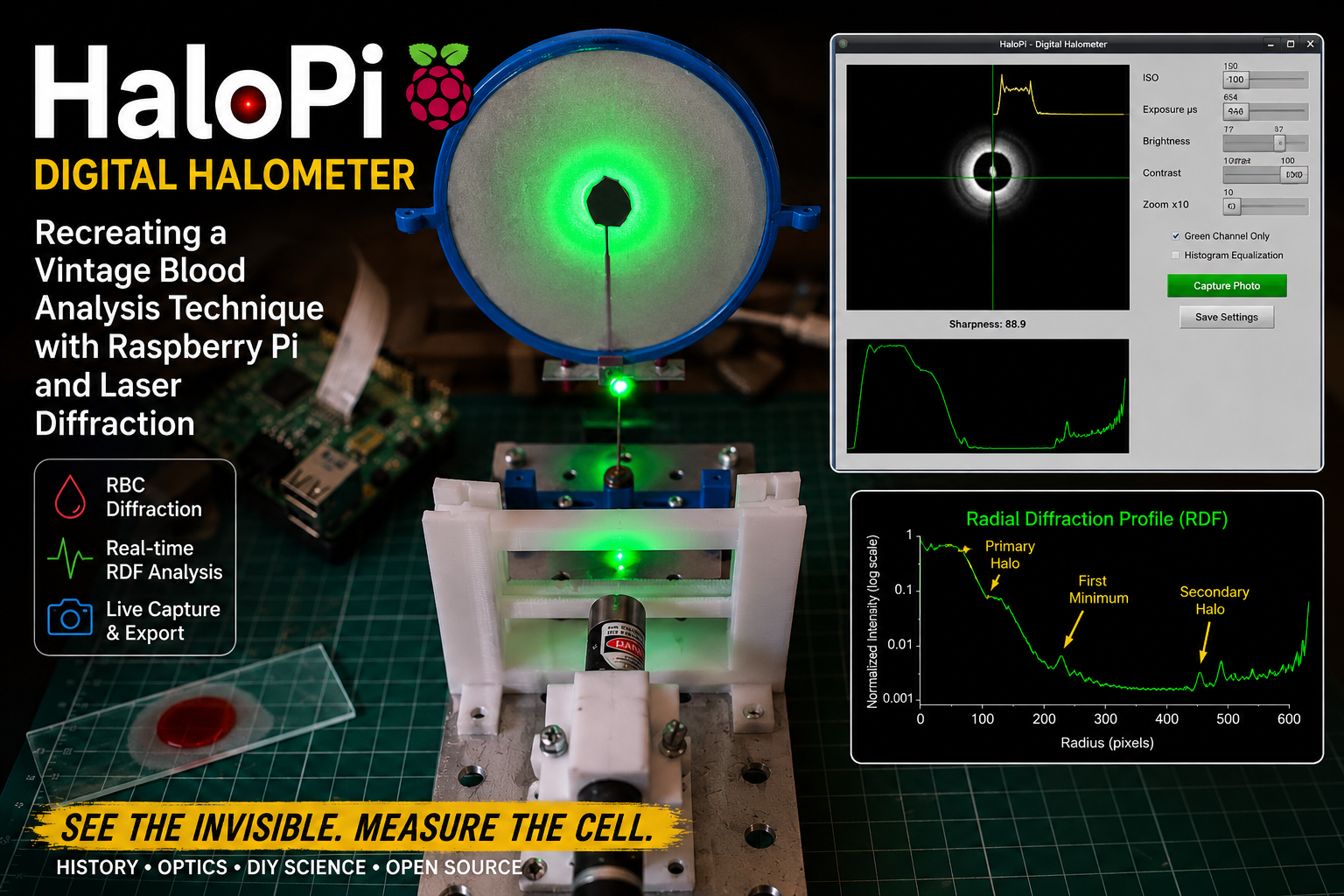
Inspired by these historical experiments, I developed a modern digital reinterpretation of the halometer using inexpensive maker components. The project combines:
- a Raspberry Pi,
- a Pi Camera,
- a low-cost green laser,
- a custom 3D-printed microscope-slide holder,
- and a Python-based image-analysis interface.
The setup projects diffraction rings generated by a blood smear onto a translucent screen, while the Pi Camera captures the diffraction patterns in real time. The accompanying software computes and displays a Radial Diffraction Function (RDF), allowing the diffraction intensity profile to be visualized and analyzed interactively.
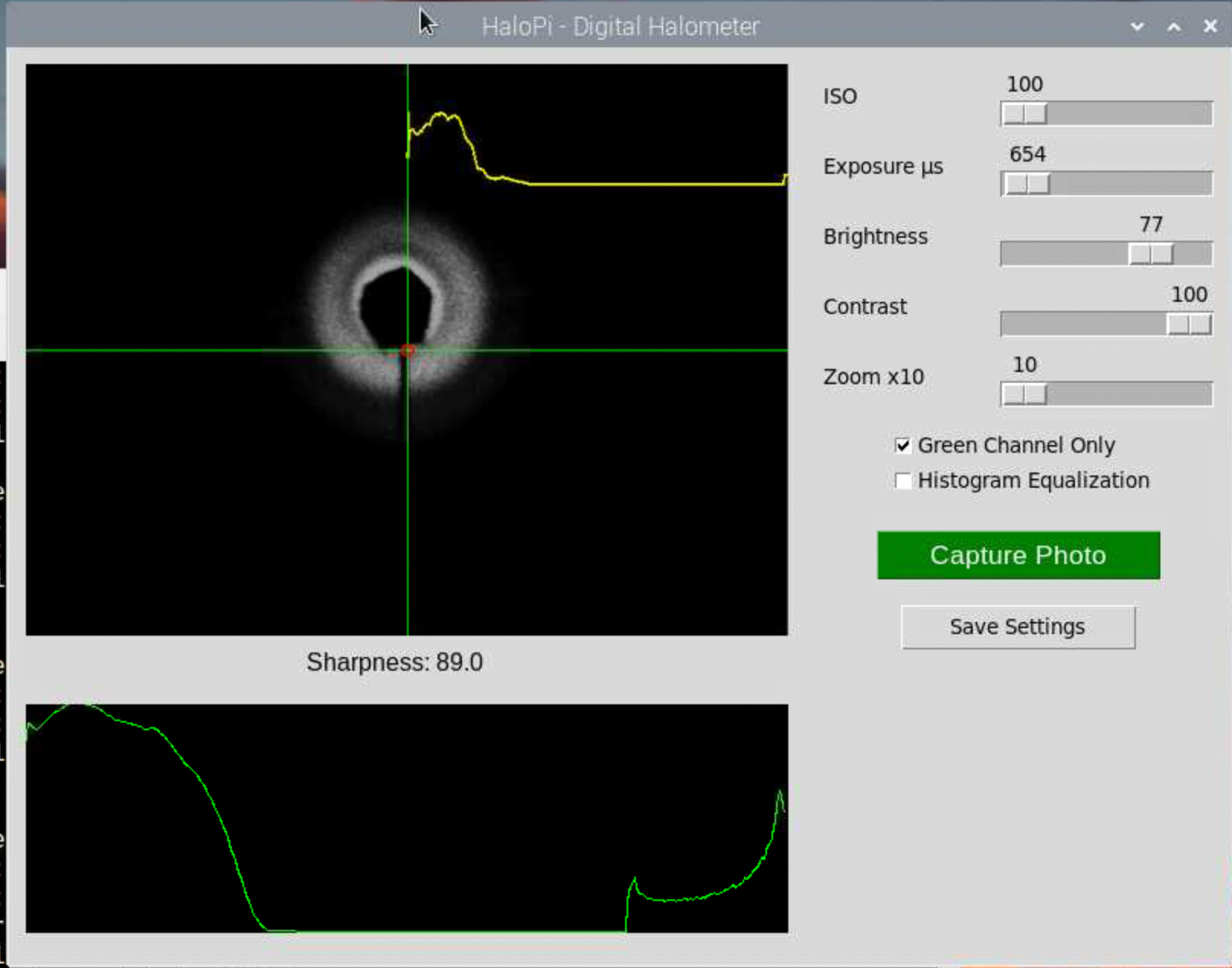
One particularly interesting aspect of the project was the exploration of the many practical limitations of real optical systems. The experiments revealed how strongly the diffraction patterns are influenced by:
- the quality and thickness of the blood smear,
- optical alignment,
- beam-stop geometry,
- laser coherence,
- speckle noise,
- and imperfections in inexpensive laser pointers.
Several image-processing techniques were implemented during development, including:
- logarithmic RDF visualization,
- green-channel filtering,
- radial averaging,
- and live overlay intensity profiles directly on the diffraction image.
Although the current version remains a preliminary experimental prototype, the project demonstrates how historical scientific techniques can be revisited and enhanced using modern open-source hardware and software. It also provides an accessible introduction to diffraction physics, biomedical optics, image processing, and computational instrumentation.
The Instructable includes:
- the complete optical setup,
- construction details,
- the simplified HaloPi Python software,
- experimental observations,
- and discussions about possible future improvements, including automated ring detection and quantitative estimation of red blood cell diameters.
Projects like this remind us that many elegant scientific ideas from the past can still inspire new experiments, educational tools, and maker projects today.
You can read the complete Instructable here:
HaloPi: a Raspberry Pi Halometer for Measuring Red Blood Cells


