Il metodo degli orbitali molecolari di Hückel è un metodo quanto meccanico semi-empirico usato per calcolare le proprietà degli orbitali molecolari degli elettroni π in sistemi d’idrocarburici coniugati, come, per esempio, l’etilene, il benzene o il butadiene. In questa serie di articoli, ho riassunto gli aspetti principali della teoria con esempi pratici di applicazioni e programmazione del metodo.
Continue readingWhat is new

Easter 2022: Modelling and Designing of Birds Eggs for 3D Printing
A box without hinges, key, or lid,
JRR Tolkien, The Hobbit
Yet golden treasure inside is hid.
Easter 2022 is at the door and the occasion for the traditional appointment to talk about eggs and their mathematical shapes. This year with the help of my sons, we have created the following Instructable for STEM education:
https://www.instructables.com/Modelling-and-Designing-of-Bird-Eggs-for-3D-Printi/
The project aims to show how to use a simple mathematical model to generate the 3D form of real bird eggs utilizing several parameters. The 3D egg models can be saved as an STL file and then printed using a 3D printer. The printed egg can be painted or modified with a CAD program to add functionalities for egg-based gadgets or toys. An example of a modification to create a LED decorated egg is explained in detail.
More recently for fun, I have published another one using the same approach:
https://www.instructables.com/The-Eggyrint/
The egg modelling topic has been covered in previous article, and the interested reader can complement the information in the Instructable with other information provided in the following articles:
https://wordpress.com/post/daniloroccatano.blog/3792
https://wordpress.com/post/daniloroccatano.blog/5171
https://wordpress.com/post/daniloroccatano.blog/6760
The Instructable gives the possibility to 3D print and modifies the 3D shape of bird eggs. It can be used for research, teaching and fun. I hope you will enjoy it, and constructive comments and suggestions are always welcome!
AUGURO A TUTTI I LETTORI UNA BUONA PASQUA E PACE IN TERRA
WÜNSCHT ALLEN LESERN FROHE OSTERN UND FRIEDEN AUF ERDEN
I WISH TO READER A HAPPY EASTER AND PEACE ON EARTH

Share this:

Come Creare Modelli Tridimensionali di Conchiglie e altri Molluschi
Questo articolo è la traduzione di un recente instructable in lingua inglese sul sito Instructables teachers (https://www.instructables.com/How-to-Generate-and-3D-Print-Seashells-and-Other-M). Sull’argomento ho già scritto un altro breve articolo (anche questo in lingua inglese) nel passato, tuttavia, visto il considerable interesse ricevuto dall’instructable ( che ha vinto anche un premio runner-up nella competizione “made with math”) ho deciso di farne una traduzione per i lettori italiani del mio blog.
Continue readingShare this:

Exploring the Lotus Effect using Candle Soot
I recently published an new Instructable that is the results of some home experiments that I did some time ago (see also my previous article).
https://www.instructables.com/EXPLORING-THE-LOTUS-EFFECT-USING-CANDLE-SOOT/
It shows how to prepare these simple surfaces and make some interesting observations with them. Like the previous two Instructables, my family help me a lot in preparing it in the very short time of one day. So a big thank you to my wife, Francesco, and, in particular, to Leonardo.
Hydrophobic and super-hydrophobic surfaces are ubiquitous in the natural world. You do not need to search much to find good examples: just walk out in your garden after a light rain and look at the plenty of weed leaves pearly decorated by water droplets. If you have an ornamental pond, you may have even the chance to see floating better examples of plants having a super-hydrophobic surface. Notably, wettability in Nature is present in a different form that subtle differences in the function and effect on the water droplets. Plant leaves need to keep their surfaces clean for light-harvesting efficiency. A water repellent leaves let water drops roll over its surface and mechanically remove dust particles. This effect was first noted on leaves of the Lotus plant, and for that reason, it is also called the Lotus effect.
Several novel technological materials exploit the properties of super-hydrophobic. For example, in your kitchen, Teflon pans are used to avoid sticking food residuals and therefore easily cleaned. Your car windows are teated to let the water easily roll over the surface.
Candle soot is an artificial material that is easy to produce and can be used to demonstrate some of the properties of the (super)-hydrophobic surface existing in nature.
Share this:

The Mighty Roto-Microscope
I am happy to announce our second Instructable project. Like the first one, it was a long-standing idea that was rolling in my mind for a long time. The current limited travelling mobility due to the COVID offered more time to develop this idea during my vacation. In a joyful collaboration with my son Leonardo, we managed to realize this useful device in a very short time.
This project aimed to develop a device that integrated with a cheap USB microscope allows taking 3D pictures of small samples. The project is meant to be an education STEM activity to learn using Arduino, 3D image reconstruction, and 3D printing by creating a useful piece of equipment for doing some exciting science activity. Like my previous project, it is also a moment to share good and educative time with my family and in particular, my elder son Leonardo that helped me in creating this instructable and evaluating the device as an enthusiastic STEM student. This time, also my lovely wife helps me to make a video of the assembly of the equipment!
The roto-microscope allows controlling the position of a simple USB microscope around the sample. This allows to take accurate pictures from different angles and not just from the top as in the traditional microscopes. This is not a new idea as there are professional microscopes. However, this device means to be affordable for a student and still provides some similar results and a lot of fun in building it. Other similar and excellent OpenSource projects are available (see, for example, the Ladybug microscope, the Lego microscope, and the OpenScan project), our project adds an additional option and I hope that you enjoy making it as we did!
If you find it an interesting device then instructions on how to build it are on our Instructable.
Share this:

The Magic Sand Slicer
We have published for the first time a project on Instructables: a website specialised in publishing interesting DIY projects by an effervescent community of makers and educators.
The project is called the Magic-Sand Slicer and it is an education project initially conceived as a STEM activity to learn using Arduino, a 3D printer, and some exciting science. It is also a collaboration with my son Leonardo who helped me in evaluating the device as a STEM student. We have learned a lot together, and we want to share the results of this long journey. This project aims to create a device that automatically makes sections of a cylinder of easy-to-cut coloured material. That can be used for practising 3D image reconstruction of the coloured blogs hidden in the column. The so-called Magic-Sand (c), also known with other trademarks names, becomes suitable for this experiment.
What is the point of making pictures of thin layers of sand and then reconstructing it digitally? Is it just for the fun of it? It varies on who is using it. However, students and teachers from different disciplines (e.g. geology, biology, medical) can find it a helpful education device to practice with image reconstruction from the serial sections. It could also be of interest to a geologist interested in sedimentary material plasticity to study rock and the secrets it beholds, or to a process, engineering to emulate the packing of fine granular materials. Finally, an artist can make a fantastic program of unravelling magic forms generated by packing coloured sand.
I was surprised that the project got so much interest in a very short time and I thank the Instructable community for their nice welcome! If you like to know more about the project (and try it!) then you can read our instructable here.
I also just realized that the Instructable was reviewed on the Arduino blog site by the Arduino team!
Share this:

Seminar Series: Molecular Dynamics Simulation of Biomolecules
In this new series, I will post slides of seminars or lessons that I have delivered in the past years. Some of the reported information is updated, but still helpful. In some cases, I have added descriptions of the slide contents or references to other articles or the original paper where I describe my research results.
I hope you like the presentation, and remember to add your feedback and subscribe to have email notifications about my new blog posts.
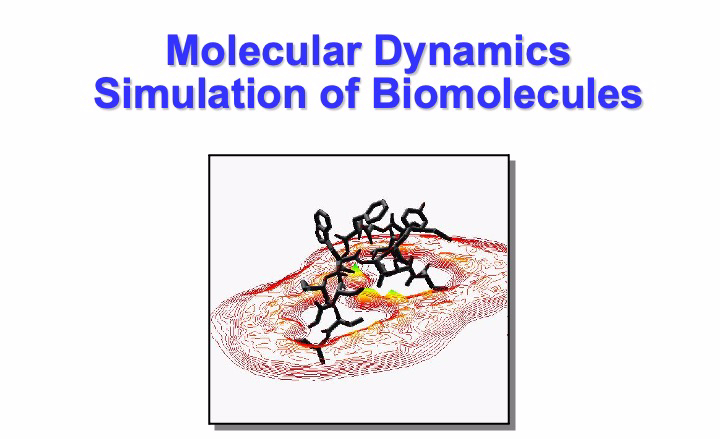
In 1648, Isaac Newton published his first edition of the Principia Mathematica, one of the greatest scientific masterpieces of all time. On page 12 of this magnum opus, the famous three laws that bear his name and from which classical mathematical physics evolved are enunciated. More than 350 years after that publication, the same laws formulated to explain the motion of stars and planets remain valuable for us when trying to simplify the description of the atomic world. In the first decades of the last century, the birth of quantum mechanics marked the beginning of the detailed description of atomic physics. The equation of Schrödinger, to the same extent as Newton’s equations, allowed for the mathematically elegant formulation of the shining theoretical intuitions and the experimental data accumulated in the previous decades. Although this equation could be used in principle to describe any molecular system’s physicochemical behaviour, it is impossible to resolve analytically when the number of electrons is more than two. The invention of electronic computers after World War II facilitated the numerical solution of this equation for polyatomic systems. However, despite the continuous and rapid development of computer performance, the ab-initio quantum-mechanical approach to describe static and dynamic properties of molecules containing hundreds or even thousands of atoms, as for biological macromolecules, is still far from becoming a standard computational tool. This approach requires many calculations that can be proportional to 
Share this:

Easter 2021: Modelling Forms in Nature: Easter Chocolate Eggs
This year, your Highness, we will be featuring square eggs.
Peter Carl Fabergé
The Easter Math Bunny is back again, and he is talking again of … eggs!
I ended my blog two years ago with a question, “What about chocolate egg shapes?” It is now the time to give some answers. If you have read my previous articles, I and many scientists and artists have been caught by the shape of bird eggs. Several models have been proposed to reproduce the silhouette of bird eggs. Baker [1] proposed a simple two-parameter mathematical model based on projection geometry that was revealed to be versatile and accurate in producing the shapes of a large variety of bird eggs [1]. More recently, the model was used to perform a systematic and comparative study of the shape of 1400 bird egg species [2].
Share this:

Retro programming nostalgia IV: L’Equilibrio e la Titolazione Acido/Base (Parte II)
Questo secondo articolo continua il mio personale viaggio retro-computazionale delle titolazioni acido/base. Nell’articolo precedente, ho mostrato come calcolare un equilibrio acido base per acidi e basi forti. In questo articolo, vengono descritte anche le subroutines per le titolazioni di acidi e basi deboli monoprotici. Il metodo che ho usato risolve in modo esatto il calcolo dei pH e si basa su articolo pubblicato sulla rivista di chimica “Rassegna chimica” da Prof Luigi Campanella (e Dr G. Visco) nel 1985. Ricevetti dall’autore stesso una copia dell’articolo quando frequentavo il suo corso di chimica analitica presso l’Università “la Sapienza” di Roma. Ricordo che scrivere un programma per lo studio delle titolazioni non solo fu divertente e stimolante ma mi aiutò molto a capire a fondo l’argomento. Pertanto raccomando il giovane lettore di provare a convertire il programma in un linguaggio moderno a voi più familiare (per esempio il Python) per meglio comprenderne il funzionamento.
Continue readingShare this:

Physical Chemistry: The Simple Hückel Method (Part IV)
In the previous parts, we learned how to set up the Hückel determinant for conjugated linear and cyclic molecules and calculate the energy and coefficients of molecular orbitals. In this new article, we will use the SHM to calculate different molecular properties. These properties help understand the structure and reactivity of organic molecules.
CALCULATION OF THE pi-ELECTRON DENSITY
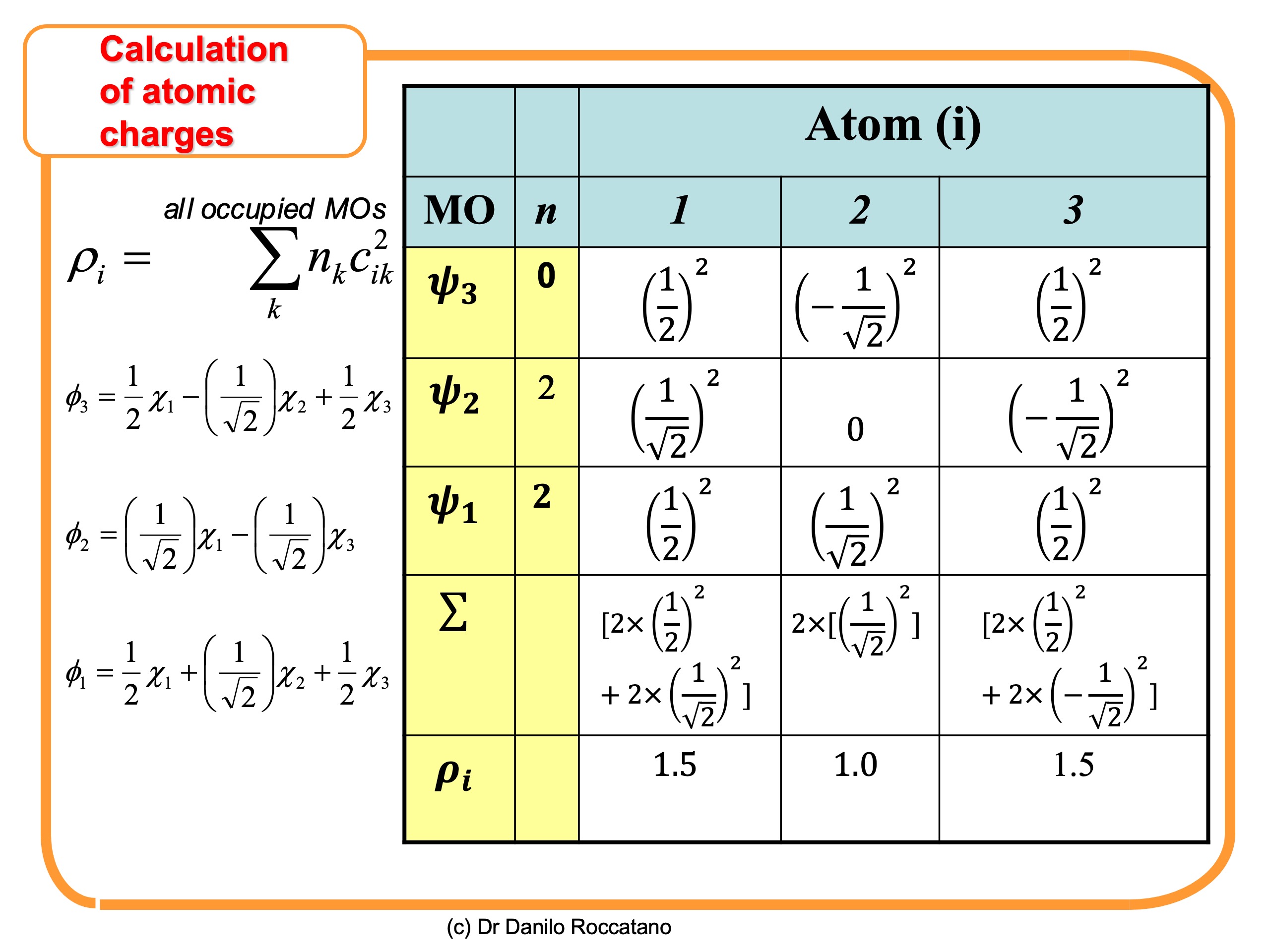
The electron density quantifies the amount of electronic charge localized around each atom in the molecule. This information gives a valuable estimation of the electrostatic (partial) charge on each atom of the aromatic system. The concept of fractional charge seems to undermine the idea of an electron as a particle. Still, it is a consequence of the probabilistic interpretation of the quantum realm. The Copenaghen interpretation of quantum mechanics theory states that the square of the wave function, associated with the description of the quantum particle’s wave nature, provides a probability density function (PDF). Whose multiplication with the infinitesimal volume of space produces a probability of localizing the particle in that volume. Therefore, the squared orbitals functions obtained by the SHM can be used to get the amount of negative charge on each atom of the aromatic system. For this purpose, we can sum the square of wave function coefficients of all the occupied orbitals

where 

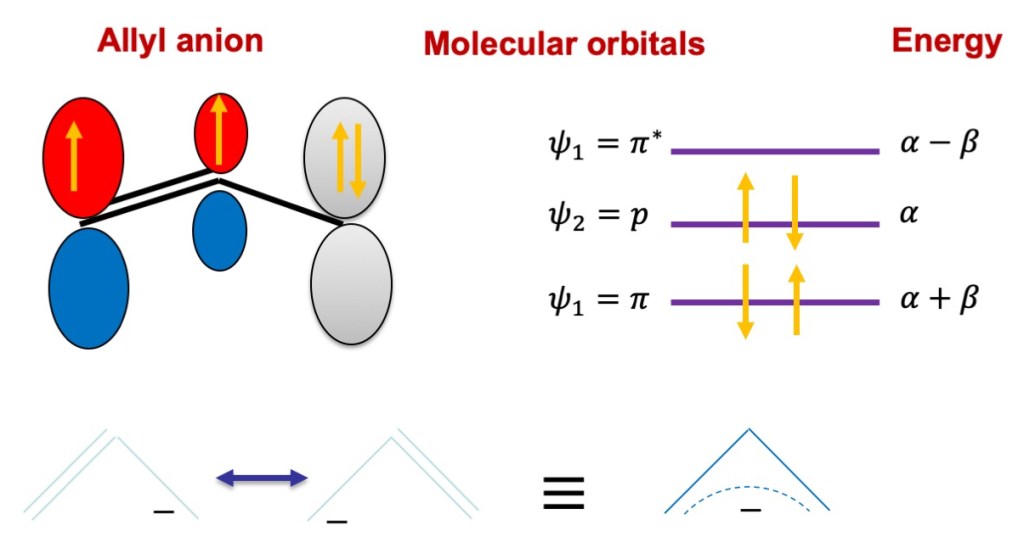
The Figure above shows the molecular orbitals for the allyl anion. Let’s now calculate the electron densities on the atoms of these molecules using the formula given before.
CALCULATION OF THE BOND ORDER
The bond order is another valuable property that can easily be derived from the HMO coefficients. It gives tha $#\pi-$$electron distribution in the bonds instead of on the atoms. It is defined as

In the following Figure, the calculation of 
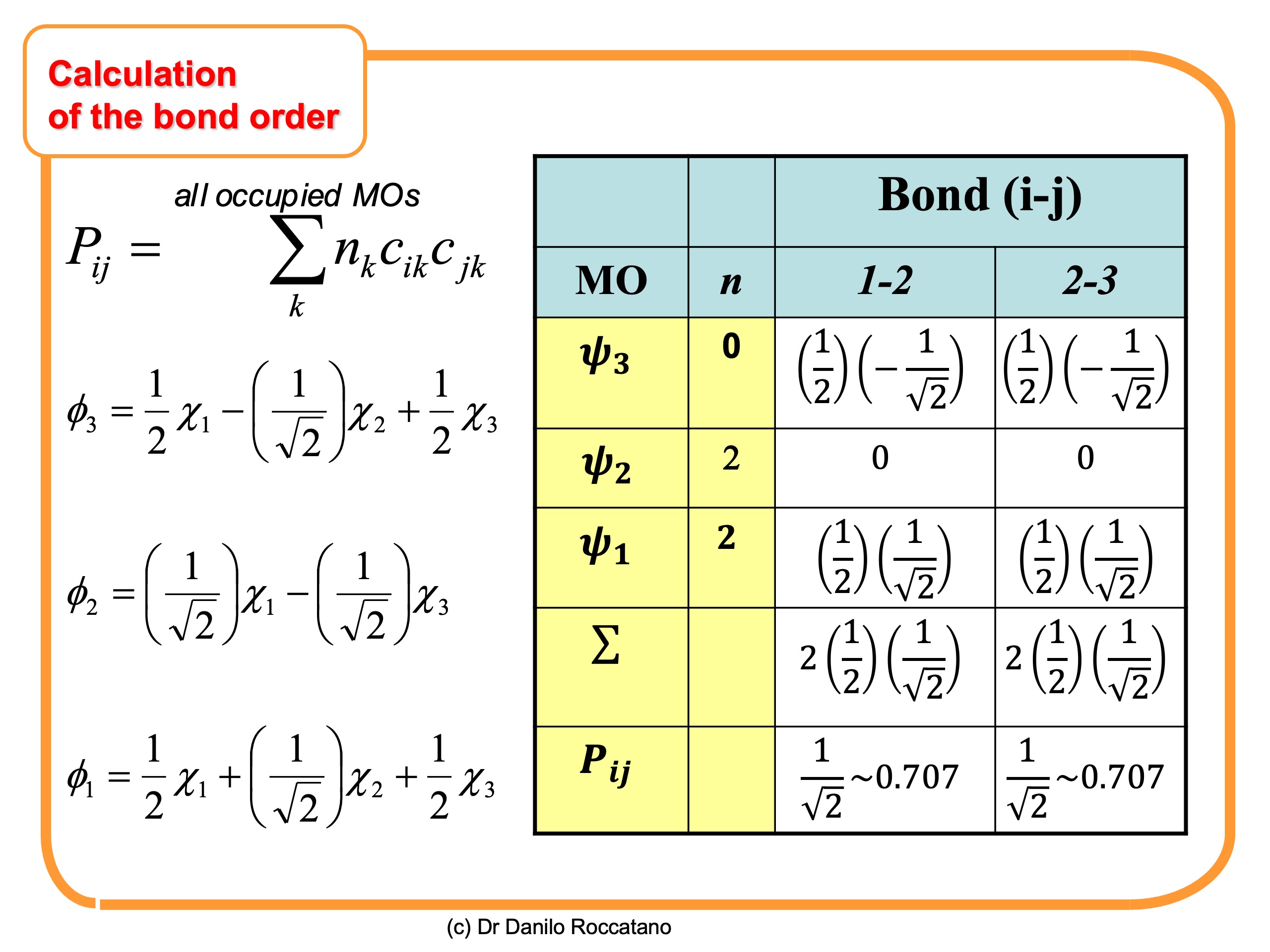
The total bond order is obtained by adding the sigma bond (1) to 

For hydrocarbons, there is a correlation between bond order and bond lenght that can be used to make an approximate prediction of bond lenght variations. C.A.Coulson in article of 1939 has proposed the following formula that can be used to estimate the effect of the bond order on the length variation of a single bond
$$R=s-\frac{s-d}{1+\frac{k(1-p)}{p}}$$
where s is the average single bond length taken equal to 1.54 A for C-C, d, the double bond length equla to 1.337 A, p the bond order, and k an adjustable parameter. For the example given before, gor p=0.707 and k=0.795, the value of R is
$$R=1.54-\frac{1.54-1.337-d}{1+\frac{0.795(1-0.707)}{0.707}}=1.54-0.153=1.387 \AA$$
CHEMICAL REACTIVITY INDECES
CALCULATION OF THE FREE VALENCE
Finally, the free valence is defined as the difference between the maximum possible bond order and the actual tital bond order. It is defined as

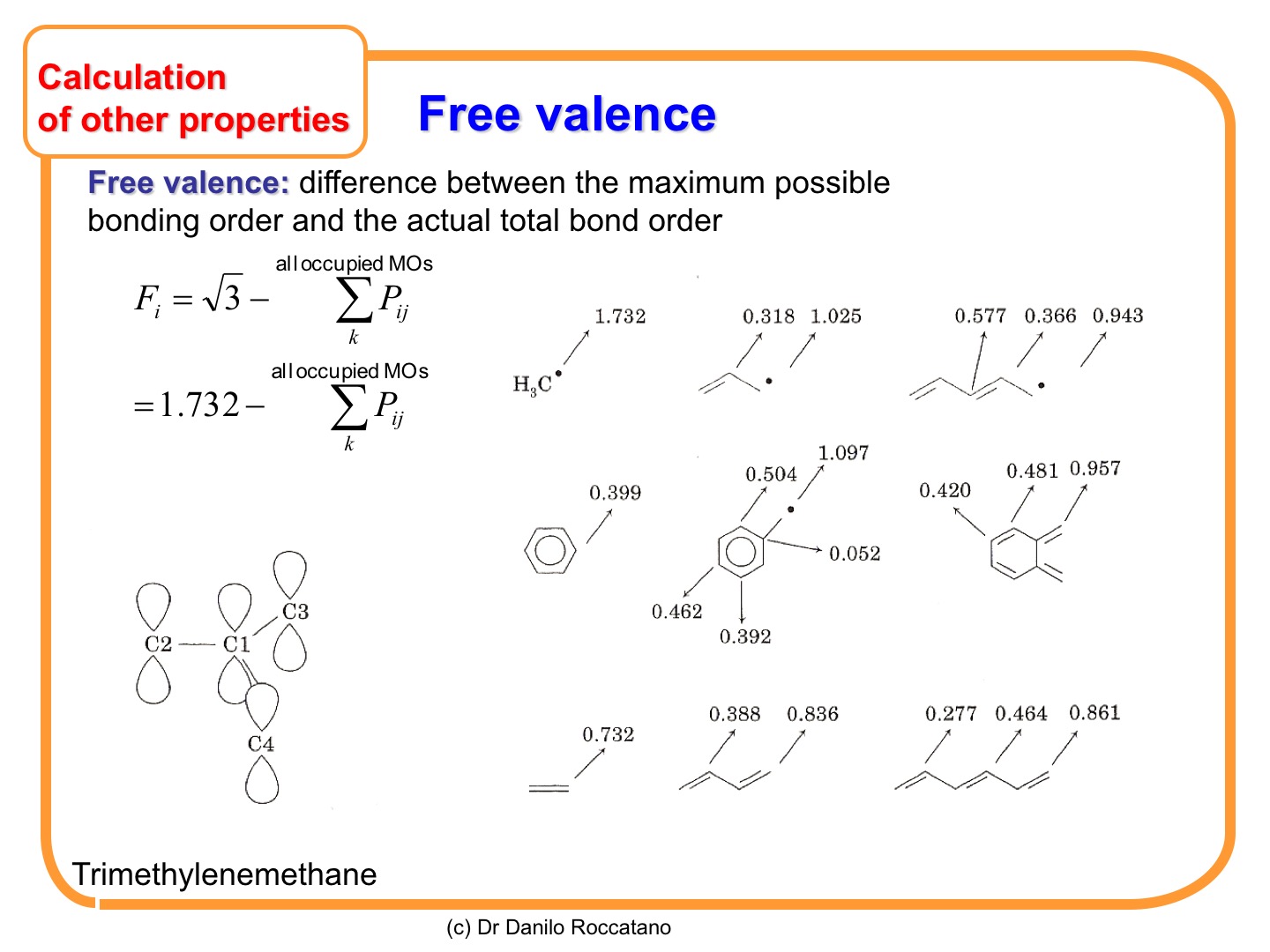
UNDER CONSTRUCTION
If you have found interesting and useful my article, do not forget to press “Like it” and subscribe for updates on new ones!
REFERENCES
- J. P. Lowe. Quantum Chemistry. 1993, Academic Press.
- F.A. Carroll. Structure and Mechanism,1998, BROOKS/COLE Publishing Company.

 daniloroccatano.blog