"… I seem […] only like a boy playing on the sea-shore, and diverting myself in now and then finding a smoother pebble or a prettier shell than ordinary, whilst the great ocean of truth lay all undiscovered before me". – Isaac Newton.
One year ago, I wrote an article about the modelling of the egg shapes, promising at one point to come back on the topics. A next step in studying eggs shapes is to look to real one or a copy of it. A happy occasion for experimenting with the model using three-dimensional graphics and 3d Printing! That is a natural indeed step: take half of the symmetric curve representing the egg shape
,
where and are two parameters, and rotate it around the central axis
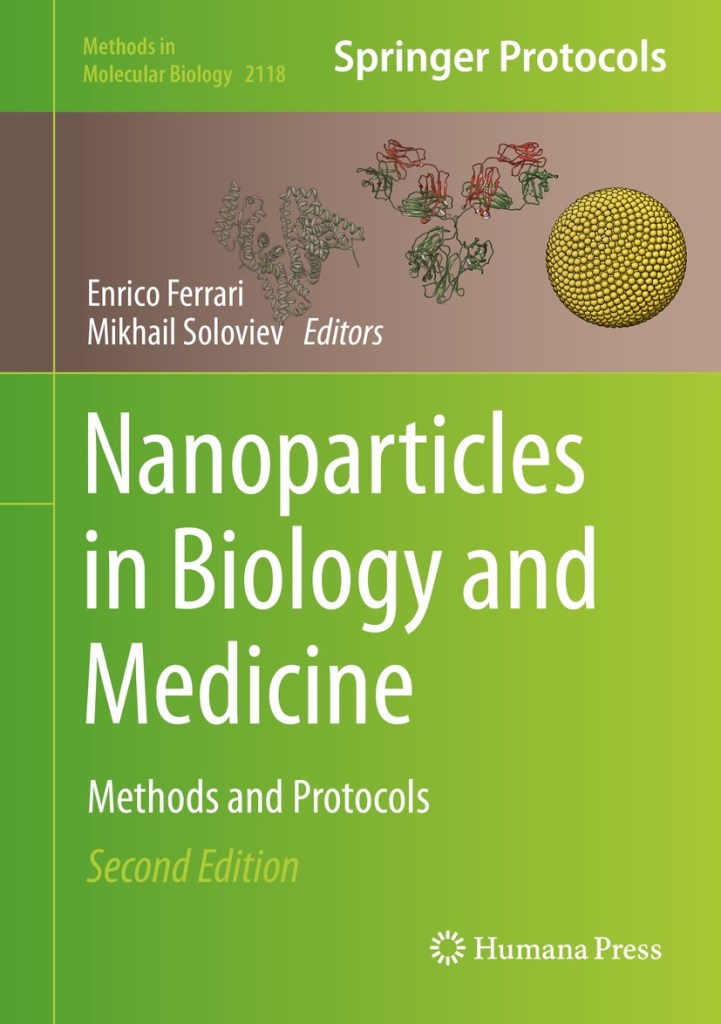
This fully updated volume presents a wide range of methods for synthesis, surface modification, characterization and application of nano-sized materials (nanoparticles) in the life science and medical fields, with a focus on drug delivery and diagnostics. Beginning with a section on the synthesis of nanoparticles and their applications, the book continues with detailed chapters on nanoparticle derivatization, bio-interface, and nanotoxicity, as well as nanoparticle characterization and advanced methods development. Written for the highly successful Methods in Molecular Biology series, chapters include introductions to their respective topics, lists of the necessary materials and reagents, step-by-step, readily reproducible laboratory protocols, and tips on troubleshooting and avoiding known pitfalls. Authoritative and cutting-edge, Nanoparticles in Biology and Medicine: Methods and Protocols, Second Edition serves as an ideal guide for scientists at all levels of expertise to a wide range of biomedical and pharmaceutical applications including functional protein studies, drug delivery, immunochemistry, imaging, and more.
I have contributed with a chapter (14) titled The Molecular Dynamics Simulation of Peptides on Gold Nanosurfaces.
In this chapter a short tutorial on the preparation of molecular dynamics (MD) simulations for a peptide in solution at the interface of an uncoated gold nanosurface is given. Specifically, the step-by-step procedure will give guidance to set up the simulation of a 16 amino acid long antimicrobial peptide on a gold layer using the program Gromacs for Molecular Dynamics simulations.
Houston, Tranquillity Base here. The Eagle has landed.
Neil Armstrong
Questo è il secondo articolo di questa serie dedicata alla soluzione numerica delle equazioni differenziali. La serie prende spunto dagli eventi che hanno portato l’uomo sulla Luna.
Nel luglio del 2019, quando ho iniziato a scrivere questo articolo, ricorreva il 50esimo anniversario della missione Apollo 11 (Neil A. Armstrong, Edwin A. Aldrin and Michael Collins) in cui gli astronauti Armstrong, Aldrin hanno posato il piede sulla superficie lunare. Un evento epocale nella storia umana che segna anche l’inizio della esplorazione spaziale. Dopo 50 anni, la NASA come altre agenzia spaziali e compagnie private, si stanno preparando per tornare sulla Luna per creare avamposti per l’esplorazione umana di pianeti più distanti come per esempio Marte. Questo anniversario mi portò ad interessarmi per raccogleire idee per la mia attività d’insegnamento e per curiosità personale, alle tecniche d’integrazione numerica delle equazioni differenziali usate per effettuare i calcoli delle traiettorie dal sistema di guida delle astronavi Apollo e dai calcolatori che hanno assistito l’impresa dalla Terra. In questo articolo semi divulgativo riassumo le informazione che ho raccolto leggendo (in maniera incompleta) la documentazione della NASA e quella ottenuta leggendo dei libri sull’argomento. Come mio solito presenterò anche dei semplici programmi che implementano questo algoritmi.
“If you know the enemy and know yourself, you need not fear the result of a hundred battles. If you know yourself but not the enemy, for every victory gained you will also suffer a defeat. If you know neither the enemy nor yourself, you will succumb in every battle.”
SunTzu. The Art of War
A virus is the Bauhaus of the form of life: the minimalist reduction of an organism to its essential element of functionality. More pragmatically, it is a container of genetic code provided with a smart mechanism that allows it to invade cells of another host organism. As a molecular machine, a virus can resemble in shape and destructive power the Death Star spaceship of the Star War saga. Therefore, it is a molecular machine that we do not definitively want to have within us!
The spread of the coronavirus SARS-CoV-2 has produced a new pandemic, i.e. an infection caused by a pathogen that affects the entire population of a living species, in this case the human one. This global emergency situation is the result of a natural competition between living species that reminds us that we are still a small brick of the Gaia ecosystem. However, although it is always difficult to believe given the state in which we have reduced our planet, we are the most intelligent life form in the known universe. So it would be quite embarrassing to be defeated by an invisible enemy.
In a previous article, I have shown a simple derivation of the properties of a quantum particle confined in a one-dimensional box. Although the model is straightforward with unrealistic assumptions, such as the infinite walls, it produced qualitative results that paved the way for the development of quantum chemistry. There are several example practical applications in chemistry and nanoscience where the particle in a box model can be applied or serves as a conceptual foundation.
In 1926, the Austrian physicist Erwin Schrödinger (1887-1961) made a fundamental mathematical discovery that had a profound impact on the study of the molecular world (in 1933, Schrödinger was awarded the Nobel Prize in Physics just seven years later, his breakthrough discovery). He discovered that a quantum system’s state composed of particles (such as electrons and nucleons) could be described by postulating the existence of a function of the particle coordinates and time, called state function or wave function (, psi function). This function is the solution of a wave equation: the Schrödinger equation (SE). Although the SE equation can be solved analytically only for relatively simple cases, the development of computer and numerical methods has made possible the application of SE to study complex molecules.
Gentilissimi/e Lettori e Lettrici, Dear Reader, Sehr geehrte Leserinnen und Leser,
Grazie mille per aver fatto tappa durante le vostre peregrinazioni cibernautiche nel mio sito web e per dedicare un po’ del vostro tempo nel leggere i miei articoli. Spero che li avete trovati tanto interessanti e utili da continuate a tornare a leggermi. Voglio anticipare alcune delle prossime pubblicazioni. Tra breve usciranno nuovi titoli:
The Logistic Map and the Feigenbaum Constants: a Retro Programming Inspired Excursion.
L’integrazione numerica di equazioni differenziali, parte II: 50 anni fa l’uomo ha messo piede sulla Luna
Retro Programming: Acid-base Titration.
Retro Programming: Plant evolution.
Per il momento auguro a tutti voi di trascorrere con le vostri cari un felice Natale e di avere un nuovo anno pieno di buone notizie.
That the nobility of man, acquired in a hundred centuries of trial and error, lay in making himself the conquerer of matter, and that I had enrolled in chemistry because I wanted to remain faithful to this nobility. That conquering matter is to understand it, and understanding matter is necessary to understanding the universe and ourselves: and that therefore Mendeleev’s Periodic Table, which just during those weeks we were laboriously learning to unravel, was poetry, loftier and more solemn than all the poetry we had swallowed down in liceo; and come to think of it, it even rhymed!
Primo Levi, The Periodic Table.
This year marks the 150th anniversary of the periodic table of the elements (TPE) which currently has 118 entries, the latest arrival (the Tennessine) was discovered 10 years ago (announced in April 2010), and I feel obliged as a chemist to give some a small informative contribution to celebrate this important event.
In a recent article, I have explained the Euler’s method for solving ordinary differential equations using as a motivation the fictionalized version in the film Hidden Figures of the scientific contribution of Katherine Goble and her two colleagues to the NASA space program. As an example of application, I have also shown a program written in the awk programming language for calculating the orbits of planets of the solar system. However, my interest in astrodynamics come back to my juvenile age, when still going to high school, my parents decided to gift me a more sophisticated microcomputer than my previous one (the celebrated Commodore VIC 20). So I became a programmer of a Philips MSX VG 8010 that I still jealously own in its original box. So, powered by the versatile Federico Faggin’s Zilog Z80 processor with a clock 3.58 MHz, with an impressive (for a previous owner of a VIC20 with a mere 3.583 kB!) memory of 32 kB RAM , 16kB of video RAM and a dedicated tape-record device as storage system, I started to write more sophisticated in MSX Basic. At that time, I was eagerly following the department “Ricreazioni al Computer” by the famous computer scientist A. K. Dewdney on the magazine “Le Scienze”, the Italian edition of Scientific American. The new microcomputer allowed me to experiment with the fascinating computational topics that Dewdney was offering every month. One of these topics was dedicated to the simulation of stars using the algorithm based on the Euler integration of the Newton equation. Following the instruction of Dewdney, I managed to write a small program in MSX basic and this was the starting of my interest in computational astronomy.





 , psi function). This function is the solution of a wave equation: the Schrödinger equation (SE). Although the SE equation can be solved analytically only for relatively simple cases, the development of computer and numerical methods has made possible the application of SE to study complex molecules.


 daniloroccatano.blog