Molecular Machines within us: Citrate Synthase a Pac-Enzyme

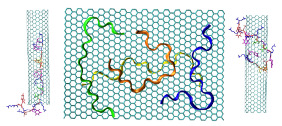
Citrate Synthase (CS) is an enzyme localized in the mitochondria of our cells where it plays an important role in the aerobic respiration cycle by transforming oxaloacetate molecules (on the right side of the picture) in citrate (on the top left side) with the assistance of the acetyl-coenzyme A (CoA) molecule. Continue reading

Exploring the Molecular Machines within us: A Fantastic Voyage


To see a World in a Grain of Sand
And a Heaven in a Wild Flower,
Hold Infinity in the palm of your hand
And Eternity in an hour.

William Blake, Auguries of Innocence.


INTRODUCTION

This blog is based on public talks that I have delivered at the University of Lincon, UK and at the Gravity Fields Festival 2016. Here I give a short summary of talk topics.

Nature is an unlimited source of great inspiration (and imitation) for scientist and engineering. In fact, the continuous advance in the knowledge of the complex machinery of life is producing profound impacts in the modern societies. Life, in the form that we know, definitively exploited what we now call nanotechnology” to emerge. Living cells are crowded with fascinating molecular machines with a large variety of functions not yet completely explored. Nature as a blind and patient engineer builds these machines without a defined blueprint but utilizing the power of the evolution.

Continue reading

Molecular Properties of Astaxanthin in Water/Ethanol Solutions from Computer Simulations

Khadga Jung KarkiSusruta Samanta, and Danilo Roccatano*

J. Phys. Chem. B, August 2016

DOI: 10.1021/acs.jpcb.6b06055

Astaxanthin (AXT) is a reference model of xanthophyll carotenoids, which is used in medicine and food industry, and has potential applications in nanotechnology. Because of its importance, there is a great interest in understanding its molecular properties and aggregation mechanism in water and mixed solvents. In this paper, we report a novel model of AXT for molecular dynamics simulation. Continue reading

2D phase Transition of Simple Liquids: Methanol on Graphene

In a recent paper [1], we have studied the phase transitions of monolayer of methanol molecules confined between two graphene sheets.

TOCNew

Structural order emerging in the liquid state necessitates a critical degree of anisotropy of the molecules. For example, liquid crystals and Langmuir monolayers require rod/disc-shaped and long chain amphiphilic molecules, respectively, to break the isotropic symmetry of liquids.

In the paper, we have presented results from molecular dynamics simulations demonstrating that in two-dimensional liquids, a significantly smaller degree of anisotropy is sufficient to allow structural organization. In fact, the condensed phase of the smallest amphiphilic molecule, methanol, confined between two or adsorbed on, graphene sheets form a monolayer characterized by long chains of molecules. Intra-chain interactions are dominated by hydrogen bonds, whereas inter-chain interactions are dispersive. Upon a decrease in density toward a gas-like state, these strings are transformed into rings. The two-dimensional liquid phase of methanol undergoes another transition upon cooling; in this case, the order-disorder transition is characterized by a low-temperature phase in which the hydrogen bond dipoles of neighboring strings adopt anti-parallel orientation.

REFERENCE

  1. R. Zangi and D. Roccatano. Strings-to-Rings Transition and Anti-parallel Dipole Alignment in Two-Dimensional Methanols. Nano Lett. 16, 5, 3142-3147, (2016). DOI: 10.1021/acs.nanolett.6b00460

Invited Seminar at Norwich

On 3rd February 2016, Danilo Roccatano visited the School of Computing Science of the University of East Anglia in Norwich hosted by Dr Steven Hayward. He gave the invited seminar:

Study of Interaction Mechanisms of Block Copolymers with Biological Interfaces

 Abstract

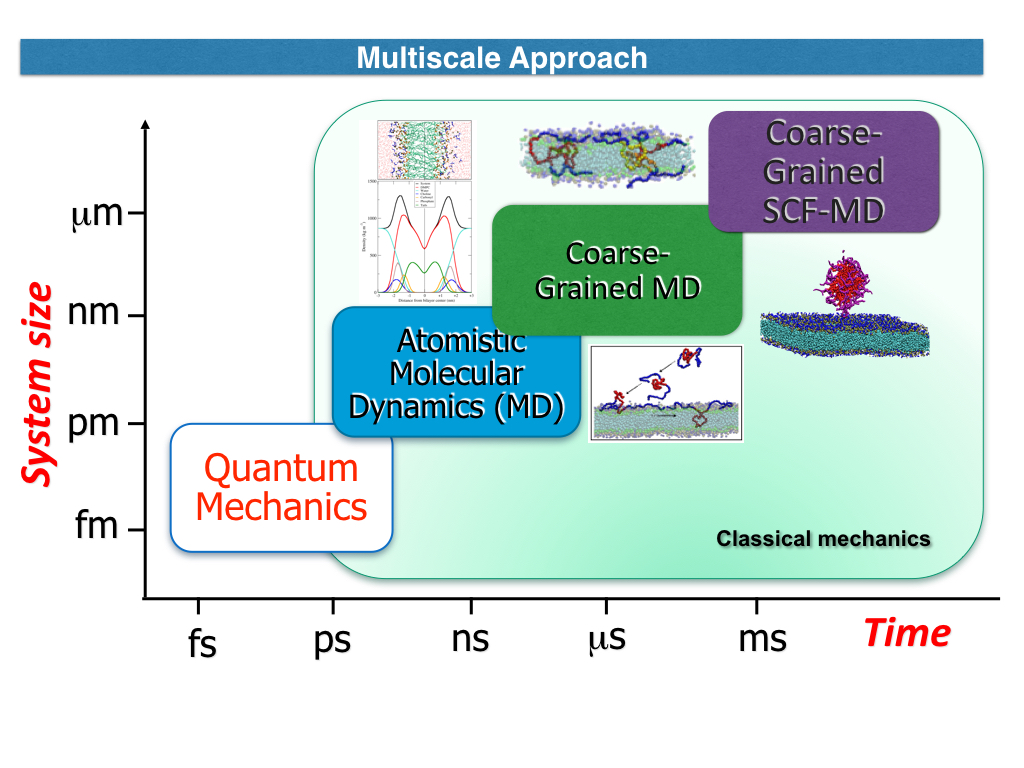
Polyethylene oxide and polypropylene oxide homopolymers as well as block copolymers based on them (Poloxamers or Pluronics®) have many applications in biotechnology and in pharmacology. This versatility is due to their biocompatibility and tuneable properties. Still the molecular mechanisms of their interactions with biological systems remain not fully investigated. A powerful and versatile approach to study these processes is the Molecular Dynamics (MD) simulation method that allows exploring these systems on scale of different order of magnitude in length and time. In the last years, we have developed for these purpose full atoms and coarse-grained models of these polymers that have been successfully tested against several experimental data in solution, and at interface with lipid bilayers. Using a recently proposed and developed Self Consistent density Field MD method, we also accomplished to perform large-scale simulations study of polymeric micelles formation and their interaction with lipid bilayers. These results have unrevealed possible mechanisms of single polymer and micelle interaction with lipid bilayers. In this talk, I will summarize the main achievements and future directions of these studies.

GraphAbstract.007