Physical Chemistry: The Simple Hückel Method (Part IV)

In the previous parts, we learned how to set up the Hückel determinant for conjugated linear and cyclic molecules and calculate the energy and coefficients of molecular orbitals. In this new article, we will use the SHM to calculate different molecular properties. These properties help understand the structure and reactivity of organic molecules.

CALCULATION OF THE pi-ELECTRON DENSITY

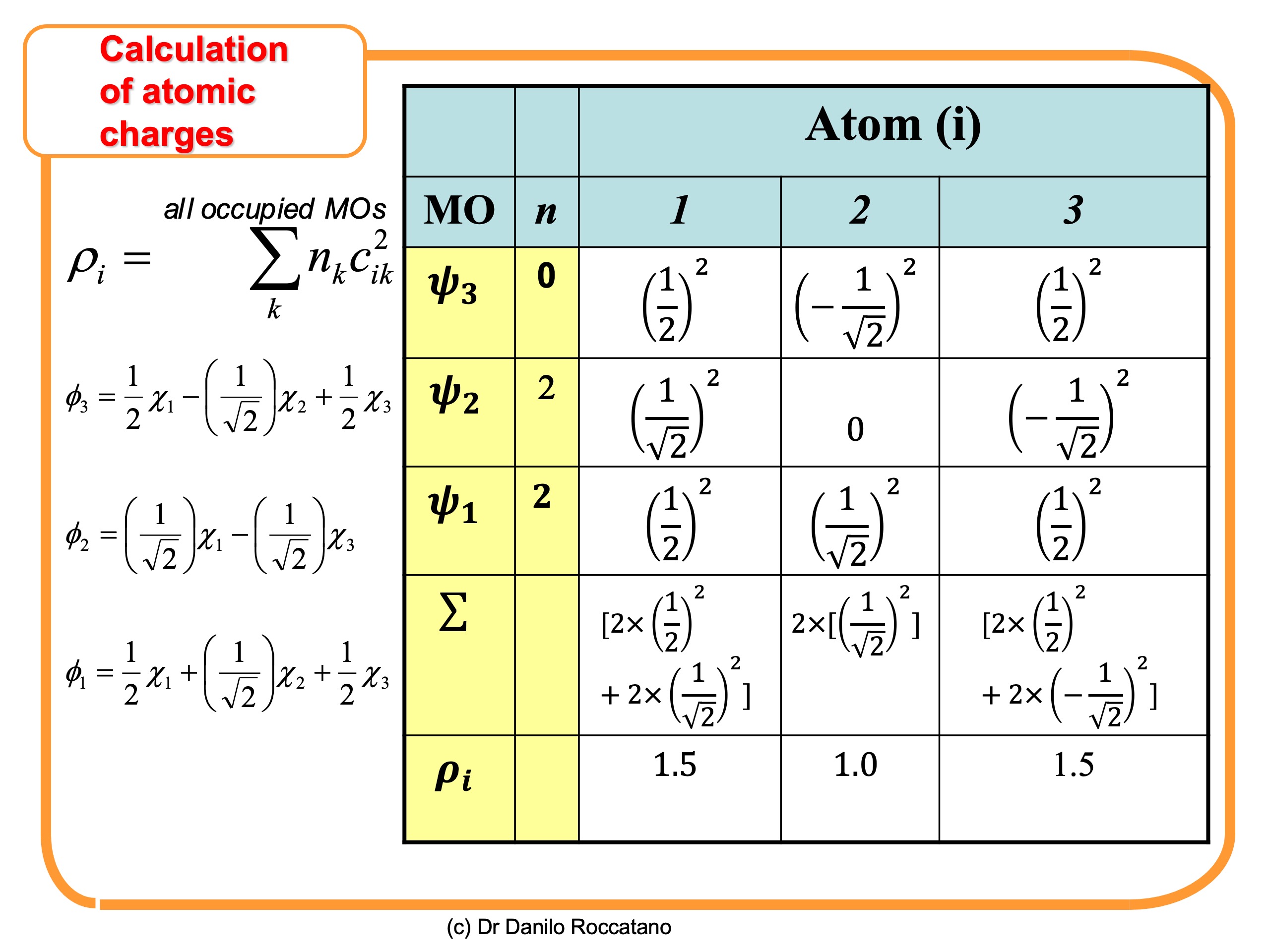
The electron density quantifies the amount of electronic charge localized around each atom in the molecule. This information gives a valuable estimation of the electrostatic (partial) charge on each atom of the aromatic system. The concept of fractional charge seems to undermine the idea of an electron as a particle. Still, it is a consequence of the probabilistic interpretation of the quantum realm. The Copenaghen interpretation of quantum mechanics theory states that the square of the wave function, associated with the description of the quantum particle’s wave nature, provides a probability density function (PDF). Whose multiplication with the infinitesimal volume of space produces a probability of localizing the particle in that volume. Therefore, the squared orbitals functions obtained by the SHM can be used to get the amount of negative charge on each atom of the aromatic system. For this purpose, we can sum the square of wave function coefficients of all the occupied orbitals

\sigma_i=\sum_k^{\textrm{all occupied MOs}} n_k c^2_{ik} (1)

where n_k is the number of electrons in the k orbital.

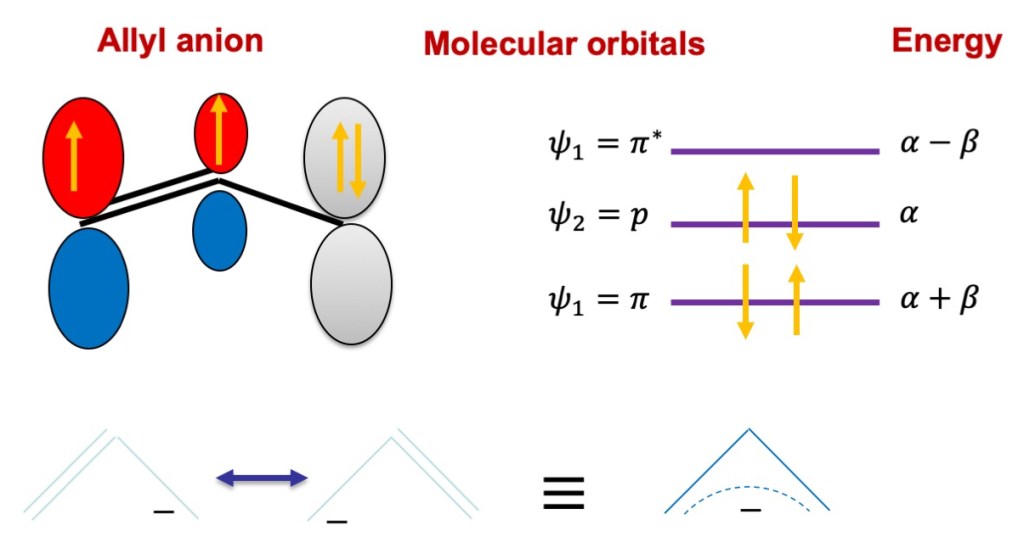
The Figure above shows the molecular orbitals for the allyl anion. Let’s now calculate the electron densities on the atoms of these molecules using the formula given before.

CALCULATION OF THE BOND ORDER

The bond order is another valuable property that can easily be derived from the HMO coefficients. It gives tha $#\pi-$$electron distribution in the bonds instead of on the atoms. It is defined as

P_{ij} = \sum_k^{\textrm{all occupied MOs}} n_k c_{ik} c_{jk}

In the following Figure, the calculation of P_{ij} of the allyl radical is reported. The result shows an equal contribution of 0.707 for both bonds.
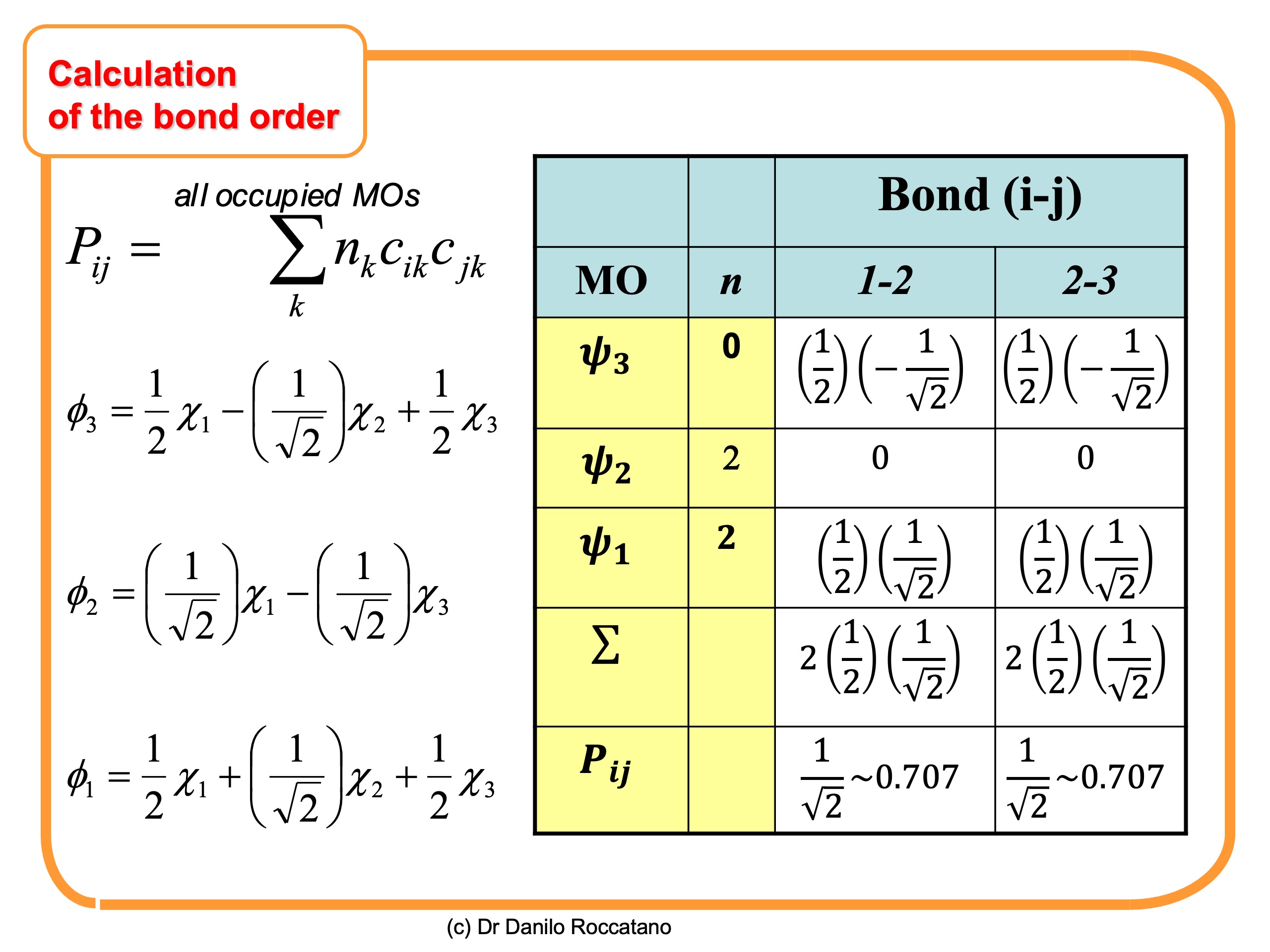
The total bond order is obtained by adding the sigma bond (1) to P_{ij} as shown in the examples reported in the figure below.

For hydrocarbons, there is a correlation between bond order and bond lenght that can be used to make an approximate prediction of bond lenght variations. C.A.Coulson in article of 1939 has proposed the following formula that can be used to estimate the effect of the bond order on the length variation of a single bond

$$R=s-\frac{s-d}{1+\frac{k(1-p)}{p}}$$

where s is the average single bond length taken equal to 1.54 A for C-C, d, the double bond length equla to 1.337 A, p the bond order, and k an adjustable parameter. For the example given before, gor p=0.707 and k=0.795, the value of R is

$$R=1.54-\frac{1.54-1.337-d}{1+\frac{0.795(1-0.707)}{0.707}}=1.54-0.153=1.387 \AA$$

CHEMICAL REACTIVITY INDECES

CALCULATION OF THE FREE VALENCE

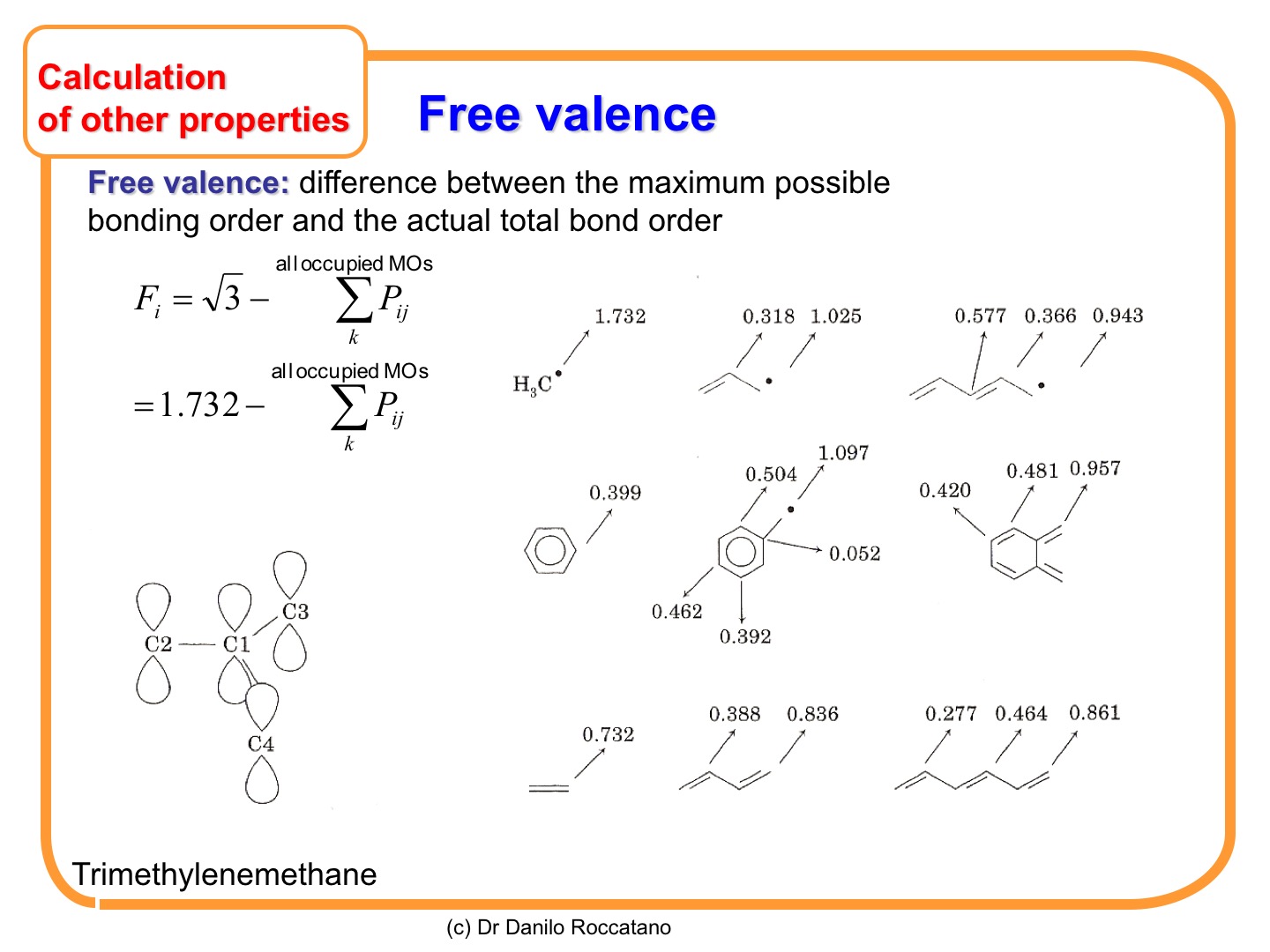
Finally, the free valence is defined as the difference between the maximum possible bond order and the actual tital bond order. It is defined as

F_i=\sqrt{3}-\sum_k^{\textrm{all occupied MOs}} n_k c_{ik} c_{jk} = 1.732 -\sum_k^{\textrm{all occupied MOs}} n_k c_{ik} c_{jk}

Slide43

UNDER CONSTRUCTION

If you have found interesting and useful my article, do not forget to press “Like it” and subscribe for updates on new ones!

REFERENCES

  1. J. P. Lowe. Quantum Chemistry. 1993, Academic Press. 
  2. F.A. Carroll. Structure and Mechanism,1998, BROOKS/COLE Publishing Company.

Physical Chemistry: The Simple Hückel Method (Part III)

In the previous article, we have learned how to set up the Hückel determinant for conjugated linear molecules based on the topology of the \pi-bonds. In this third article, we will apply the method to cyclic molecules and will derive some other useful properties.

Continue reading

Physical Chemistry: The Simple Hückel Method (Part II)

In the previous article, we have learned how to set up the Hückel determinant for an aromatic molecule based on the topology of the pi-bonds. In this second part, we are going to learn how to calculate from the determinantal equation both the eigenvalues and the eigenvectors, corresponding to the orbital energy and orbital functions of the molecular system.

Continue reading

Retro programming nostalgia IV: Acid/Base Balance and Titration (Part II)

This second article continues my journey of acid/base titrations.  In the previous article (https://daniloroccatano.blog/2020/04/14/acidsand-bases-equilibrium/), I showed how to calculate an acid-base equilibrium for strong acids and bases. This article also describes subroutines for titrations of monoprotic weak acids and bases. The method I used solves the pH calculation precisely and is based on an article published in the chemistry journal “Rassegna chimica” by Prof Luigi Campanella (and Dr G. Visco) in 1985. I received a copy of the article from the author while attending his analytical chemistry course at the University “La Sapienza” in Rome. I remember writing a program for the study of titrations was fun and stimulating, but it helped me understand the subject thoroughly. I recommend that the young reader try to convert the program into a modern language more familiar to you (e.g., Python) to understand its functioning better.

Continue reading

A Practical Introduction to the C Language for Computational Chemistry. Part 3

Sphere. From Space, from Space, Sir: whence else?

Square. Pardon me, my Lord, but is not your Lordship already in Space, your Lordship and his humble servant, even at this moment?

Sphere. Pooh! what do you know of Space? Define Space.

Square. Space, my Lord, is height and breadth indefinitely prolonged.

Sphere. Exactly: you see you do not even know what Space is. You think it is of Two Dimensions only; but I have come to announce to you a Third — height, breadth, and length.

Square. Your Lordship is pleased to be merry. We also speak of length and height, or breadth and thickness, thus denoting Two Dimensions by four names.

Sphere. But I mean not only three names, but Three Dimensions.

Adapted from: 
Flatland: A romance of many dimensions by Edwin A. Abbott

ADVENTURE IN SPACELAND

In part 2 of this tutorial, we have learned how to use arrays and how to read atomic coordinates from a file. In the appendix, you can find an example of the solution to the exercises given in the previous tutorial.

In this third part, we are going to learn how to generate three-dimensional coordination of atoms in a cubic crystal lattice and how to calculate non-bonded molecular potential and the force acting among them.

Continue reading

A Practical Introduction to the C Language for Computational Chemistry. Part 2

In the first part of this introduction to C language, we have learnt the basic of the C language by writing simple programs for the calculation of the non-bonded interaction between two particles at variable distances. Some solutions to the first part exercises are reported in the appendix of this article.

In this second tutorial, we will learn how to use arrays data types and how to load them with a set of data read from a file. We will also use these data to perform numerical calculations and write results in output files.

Arrays and Pointers Datatypes

The program that calculate the energy of interaction between two particle doe not take in account the actual position in space of the two particle but only their distance. If we want to study the dynamics of a system composed by multiple atoms in a tridimensional space, it is way more convenient to represent the and calculate their interactions by using the coordinates directly to evaluate the distances.

Continue reading

The Dandelion (Taraxacum Officinalis) and OpenCV

The dandelion’s pallid tube
Astonishes the grass,
And winter instantly becomes
An Infinite Alas —

The tube uplifts a signal Bud
And then a shouting Flower, —
The Proclamation of the Suns
That septulture is o’er.

– Emily Dickinson

The yellow flowers and the delicate and beautiful inflorescence of Dandelion catch the attention of both romantic and curious souls. The aerial consistency of the fine silk decorated seeds that glance to the sunlight as crystalline material became the favorite subject of the inspired photographers and the toy of amused children. Besides the grace of its forms, other interesting and the curious secret is hidden in its phloem fluids. In fact, if you cut one of the stems of the plant, a milky, sticky liquid will flow out of the wound resection. This latex is going to polymerize at 30-35 oC in a few minutes in a yellow-brown quite solid mass. Around the year 1982, I have annotated this observation but I could not find in my later notes further follow-ups study on the topics. It was a casual observation but I didn’t know at that time that this latex is indeed very useful. A variety of the Taraxacum (Taraxacum koksaghyz, Russian Dandelion) was used in Russian and American to produce a replacement of the natural rubber from Brazil during WWII that was in shortage because of the war. Many studies are in progress to exploit the lattice of Taraxacum and  Taraxacum brevicorniculatumas, a convenient replacement for the rubber plant lattice. A recent study has shown the presence of rubber particles in the lattice of these plants in 32% proportion composed prevalently by poly(cis-1,4-isoprene) at >95% purity (www.biomedcentral.com/1471-2091/11/11). The brownish lattice condensate that, as I reported in my note, forms after exposing the latex to the air for several minutes is caused by the presence of the polyphenol oxidase (PPO) enzyme that produces the fast coagulation of the latex by catalysing the oxidation of polyphenols. Genetic engineering the plant makes it possible to reduce the amount of PPO in the latex, making economically competitive use of this resource for latex production.

Continue reading

Crystal Structures

Cristallo e fiamma, due forme di bellezza perfetta da cui lo sguardo non sa staccarsi

Italo Calvino, Lezioni americane. Sei proposte per il prossimo millennio.

The successful reception of my previous posts on calculating the lattice energy, the calculation of the Born-Haber cycle and the Madelung constant motivated me to write more about the crystal structures of inorganic and organic compounds. In this series of articles, I will briefly introduce the crystallography. It does not pretend to be comprehensive, but it is meant to give just a flavor of this fascinating topic.

What is a Crystal?

At the atomic level, a crystal is solid with regular arrangements of atoms in space. Depending on the material, these arrangements have different symmetry properties that generate beautiful symmetric shapes at the macroscopic level.A regular and infinite arrangement of atoms can be visualized as a vast and complex network of interconnected particles. Each atom, with its unique properties, contributes to the overall complexity and variety of the system. The repeating patterns of the atoms create an endless and fascinating display. This assembly of atoms forms the basis of the world of matter, showcasing the intricate and beautiful nature of the smallest units of our universe.
We start introducing the Bravais lattice’s fundamental concept to describe and classify these atomic arrangements..The term “Bravais lattice” is a name given to a mathematical concept used to describe how points are arranged in a crystal. It is named after Auguste Bravais, a physicist from France who studied crystals in the 19th century. Bravais introduced the idea of different types of arrangements and symmetry in crystal structures. His work was important in understanding how crystals are classified based on their symmetry. The Bravais lattice is a fundamental concept in crystallography that describes the periodic arrangement of points in a crystal lattice. It provides a framework for classifying and categorizing different types of crystal structures based on their symmetry and arrangement of lattice points.

Continue reading

Chimica Fisica: La Termodinamica, La Meravigliosa Cattedrale Della Scienza. Parte I.

Indipendentemente dai motivi del culto, le antiche cattedrali invitano ad un’ammirata contemplazione, ispirano rispetto e quiete. Anche il visitatore più disinvolto non si esimere dal moderare la voce, non insiste in argomenti futili: delle navate, l’eco delle sue stesse parole sembra destare insolite suggestioni. L’impegno di generazioni di architetti e di artigiani e’ stato dimenticato, le loro impalcature sono state rimosse ormai da lungo tempo, i loro stessi errori sono stati cancellati dai secoli. Il monumento che essi crearono, ora compiuto e perfetto, ci appare come la testimonianza di un disegno sopraordinario. Se evochiamo in noi il ricordo di un cantiere in attività, con il rumore ritmato dei martelli, le voci ed i gesti degli operai, l’odore stantio del legno e di tabacco, alle splendide structure che ora ammiriamo non possiamo attribuire altro significato che quello di essere il frutto di un ordine imposto alla mera fatica umana.

Anche la scienza ha i suoi templi, costruiti con gli sforzi di pochi architetti e di molto operai, e di fronte ad essi proviamo lo stesso sentimento. Anche in questi templi l’atmosfera e’ solenne, e forse lo e’ a tal punto da condizionare l’espressione stessa del pensiero scientifico, che una lunga tradizione vuole assai severo e formale.

G.N. Lewis, M. Randall -“Thermodinamica”, Leonardo Edizioni Scientifiche, Roma (1971).

INTRODUZIONE

Gilbert Newton Lewis e Merle Randall nella introduzione alla prima edizione del loro autorevole testo di termodinamica chimica descrivono  la termodinamica come la cattedrale della scienza. La loro non è solo una concessione poetica di un’epoca ancora permeata dal romanticismo scientifico, ma una meravigliosa analogia per questa fondamentale disciplina della scienza che più di ogni altra contiene  le leggi arcane che goverano il nostro Universo e il suo destino.

In questa serie di articoli riporto alcuni appunti su argomenti vari di termodinamica chimica che possono essere utili come riferimento o come materiale didattico.

Continue reading

Programming in Awk Language. LiStaLiA: Little Statistics Library in Awk. Part I.

In the following previous Awk programming articles

The AWK Programming Language

Awk Programming II: Life in a Shell

Awk Programming III: the One-Dimensional Cellular Automaton

I have briefly introduced this handy Unix program by showing two examples of elaborate applications. In this fourth article of the series, I will offer a little library of functions that can be used for the essential statistical analysis of data sets. I have written (and rewritten) many of these functions, but I have spent little time collecting them in a library that can be used by other users. So this article gives me the motivation to achieve this target. Unfortunately, I didn’t extensively test the library, so I am releasing it as an alpha version. If you spot errors or improve it, please just send me your modified code!

READING DATA SETS

We start with a function that can be used to read data from a text file (ascii format). A good data reader should be able to read common data format such as comma separated (cvs) or space separated data files. It should also be able to spik blank lines or lines starting with special characters. It would be also handy to select the columns that need to be read and also check and skip lines with inconsistent data sets (missing data or NaNs). This is what exacty work the function ReadData() given in the Appendix. But shall we see it more in details.

ReadData(filename,fsep,skipchr,warn,range,ndata,data)

The function read the data from a file with name provided in the variable filename. The program skips all empty record, those starting with one of the characters contained in the regular expression skipchar. For example, a regular expressions such as skipchr=”@|#|;” skips the occurrence of the characters “at” or “hash” or semicolomn. The variable warn is used to check the behavior of the program if alphabetic characters or NaN or INF values are present in the data. If the variable is set to 0, the function gives a warning without stop the program, if set to 1 then the function terminate the program after the first warning.

The field separator is specified in fsep and it is used to set the awk internal variable FS and define the separator between data. The variable can be assigned with single character such as fsep=” “ or fsep=”,” or ESC codes such as fsep=FS=”\t” for tab-delimited.

The column in the data record can be read in two ways by set the element zero of the array range[]. For range[0]=0, a adjoint range of data is specified by setting the first element is at range[1] the last one in range[2]. For range[0]=1, the first element in range[1] is the number of data to read followed by the specific field in the record where the data is located.

Continue reading