Principal Component Analysis: Key to Analyzing Biomolecular Dynamics

I have recently written, for WIREs Computational Molecular Science, a review article on the use of Principal Component Analysis (PCA) in the study of dynamical systems, with a particular focus on molecular dynamics (MD) simulations of biomolecules [1]. The aim of this work is to provide a clear and practical overview of how PCA has become a central tool for extracting meaningful collective motions from high-dimensional simulation data, and how modern methodological extensions continue to expand its capabilities.

Continue reading

RaPenduLa: Una Video piattaforma Fai-Da-Te Per Studiare Oscillazioni Meccaniche

Qualche giorno fa ho pubblicato un nuovo progetto educativo sul mio sito Instructables. Il dispositivo, che ho battezzato RaPenduLa (dalle iniziali in inglese di RaspPi Pendulum Laboratory), è stato ribattezzato in italiano CAMPO (Computer Analisi Moto Pendolare Oscillante) grazie a un suggerimento di ChatGPT. Ma, come direbbe Shakespeare, ‘What’s in a name? That which we call a rose by any other name would smell as sweet’: il cuore del progetto è infatti una piattaforma video per lo studio delle oscillazioni meccaniche. Utilizzando un Raspberry Pi Zero W2 dotato di modulo fotocamera, il sistema registra ad alta velocità il movimento dei pendoli. Poi, con un’analisi video basata su Python e OpenCV, RaPenduLa è in grado di tracciare il percorso preciso della punta del pendolo, visualizzandone il comportamento oscillatorio in 2D.

Continue reading

Easter 2025: Exploring Egg-Shaped Billiards

It has become a recurrent habit for me to write a blog on the shape of eggs to wish you a Happy Easter. Not repeating oneself and finding a new interesting topic is a brainstorming exercise of lateral thinking and a systematic search in literature to find an interesting connection. This year, I wanted to explore an idea that has been lurching in my mind for some time for other reasons: billiards.

I used to play snooker from time to time with some old friends. I am a far cry from being even an amateur in the billiard games, but I had a lot of fun verifying the laws of mechanics on a green table. I soon discovered that studying the dynamics of bouncing collision of an ideal cue ball in billiards of different shapes keeps brilliant mathematicians and physicists engaged in recreational academic studies and important theoretical implications.

Continue reading

RaPenduLa: A DIY Video Platform for Exploring Mechanical Oscillations

I have recently published another educational project on my Instructables website. I called the device RaPenduLa for the RaspPi Pendulum Laboratory, and it is a video platform for studying mechanical oscillations. It uses a Raspberry Pi Zero W2 equipped with a camera module to record the motion of pendulums at high speed. The interesting part happens through video analysis: using Python and the fantastic OpenCV library, RaPenduLa can track the precise path of a pendulum’s tip and help visualize its oscillatory behavior in two dimensions.

Continue reading

A Virtual Microscope for Nanoscience

I am pleased to announce the publication of the second edition of my book chapter: “A Short Introduction to the Molecular Dynamics Simulation of Nanomaterials” [1] in Micro and Nanomanufacturing, Volume II, edited by W. Ahmed and M. J. Jackson, Springer, 2025. This new edition reflects both the rapid evolution of molecular dynamics (MD) simulations over the past decade and their growing role in nanoscience.

Molecular dynamics simulations have become a cornerstone of modern nanoscience. They allow us to observe matter at the atomic scale, following the motion of thousands—or millions—of atoms in time, effectively turning the computer into a virtual microscope. From nanoparticles and nanotubes to polymers, membranes, and bio–nano interfaces, MD simulations provide insights that are often inaccessible to experiments alone. They help us understand:

  • Structural organization at the nanoscale
  • Dynamic processes such as adsorption, diffusion, and self-assembly
  • Thermodynamic and mechanical properties relevant to material design

This chapter is written with the explicit goal of making these ideas accessible, without sacrificing physical rigor.

Continue reading

The KaleidoPhoneScope: Breathing New Life into a Classic Physics Demonstration

What if an antique scientific instrument could be reimagined to inspire modern classrooms, foster creativity, and even be used to create form of dynamic art ? Meet the KaleidoPhoneScope, a contemporary twist on Wheatstone’s classic Kaleidophone [1]. By integrating 3D printing, laser technology, and microcomputers, this revamped device transforms the teaching of physics, engineering, and even mathematics into an engaging and interactive experience.


Figure 1: The KaleidoPhoneScope. A) Diagram of the KaleidophoneScope with indications of the different parts described in the text. B) Photo of the final apparatus with the horizontal cantilever wire. C) variant with the all-flexible Γ wire.
Continue reading

How Surfactant Chain Length Shapes Protein Binding

Surfactants are everywhere in protein science — from biochemical laboratories to industrial detergents. Among them, sodium dodecyl sulfate (SDS) is perhaps the most famous (or infamous), widely used for its ability to bind, deactivate, and often denature proteins. Despite decades of experimental and theoretical work, the molecular details of how surfactants bind to protein surfaces are still not fully understood. In my recent study, “Binding Dynamics of Linear Alkyl-sulfates of Different Chain Lengths on a Protein Surface” [1], I have explored this problem using molecular dynamics (MD) simulations, focusing on how the length of the surfactant’s hydrocarbon chain influences protein binding.

Continue reading

Chlorophyll in Tight Spaces: How Silica Nanoconfinement Stabilizes Photosynthetic Pigments

In a recent molecular dynamics study [1] in collaboration with Prof. K. J. Karki (Department of Physics, Guangdong Technion-Israel Institute of Technology in China), we explored how EthylChlorophyllide a behaves when confined between two silica surfaces — a situation relevant for artificial photosynthesis, nanomaterials, and bio-inspired light-harvesting systems. Chlorophylls are among the most important molecules on Earth. They enable plants, algae, and photosynthetic bacteria to convert sunlight into chemical energy. Yet, outside their natural protein environment, chlorophyll molecules are fragile as they can easily lose their central magnesium ion (demetallation), they degrade under light, and they tend to aggregate uncontrollably in solution.

In natural photosynthetic systems, proteins protect and organize chlorophylls. Reproducing this level of control in artificial systems remains a major challenge. One promising strategy is nanoconfinement — trapping chlorophyll derivatives inside well-defined inorganic structures such as silica nanopores.

Continue reading

Look at the Rainbow in a Soap Film: A simple STEM Project

My heart leaps up when I behold 
   A rainbow in the sky:
So was it when my life began; 
So is it now I am a man; 
So be it when I shall grow old, 
   Or let me die!
The Child is father of the Man;
And I could wish my days to be
Bound each to each by natural piety.

William Wordsworth, March 26, 1802


I couldn’t resist citing the beautiful poetry by Wordsworth about the rainbow to introduce my new Instructable, ‘Explore the Physics of Soap Films with the SoapFilmScope.’ I got the idea for this project by reading an article by Gaulon et al. [1]. The authors describe in detail the use of soap film as an educational aid to explore interesting effects in the fluid dynamics of this system. In particular, they examine the impact of acoustic waves on the unique optical properties of the film. In this Instructable, we have designed a device called the SoapFilmScope to perform these experiments. This tutorial will guide you through the process of creating this device, showcasing the mesmerizing interaction between sound waves and liquid membranes. The SoapFilmScope offers an engaging way to explore the physics of acoustics, light interference, and fluid dynamics.

When a sound wave travels through the tube and vibrates the soap film, it creates dynamic patterns through several fascinating mechanisms:

The device consists of a vertical soap film delicately suspended at the end of a tube obtained from a PVC T-shaped fitting that you can get from any DIY store. By attaching a small inexpensive speaker to it, you can let the film dance to the rhythm of the music.

Continue reading

Exploring Disordered Proteins: A Study on Flexible Peptides

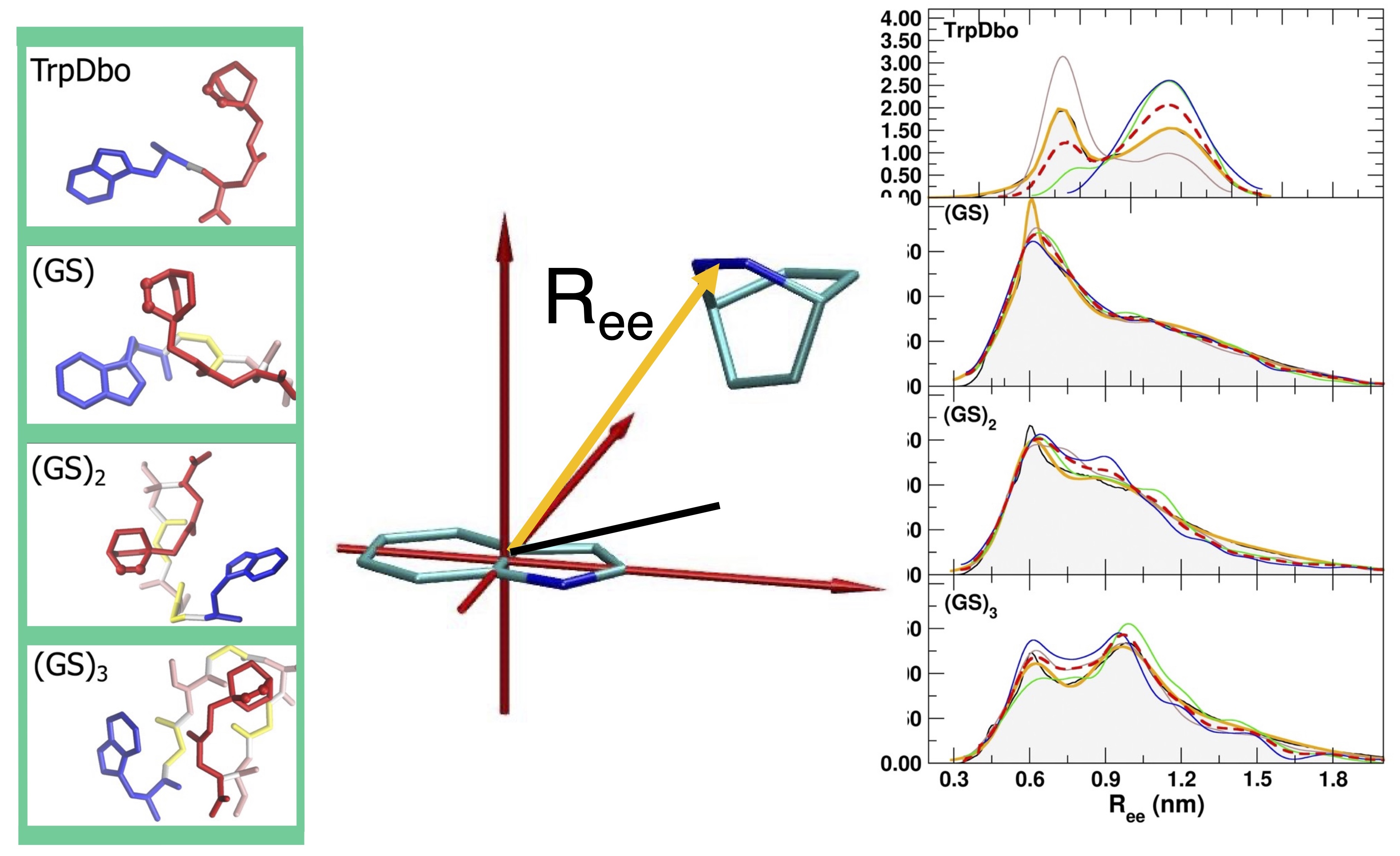
Proteins are not always rigid structures. Many of their most important parts — linkers, loops, and disordered regions — are highly flexible, constantly changing shape in solution. To understand how these regions behave, scientists often study short model peptides that capture the essential physics of flexibility. In a new article [1], I have explored the behavior of glycine- and serine-rich octapeptides using molecular dynamics simulations combined with concepts from FRET (Förster Resonance Energy Transfer) spectroscopy (see also my previous post).

Continue reading