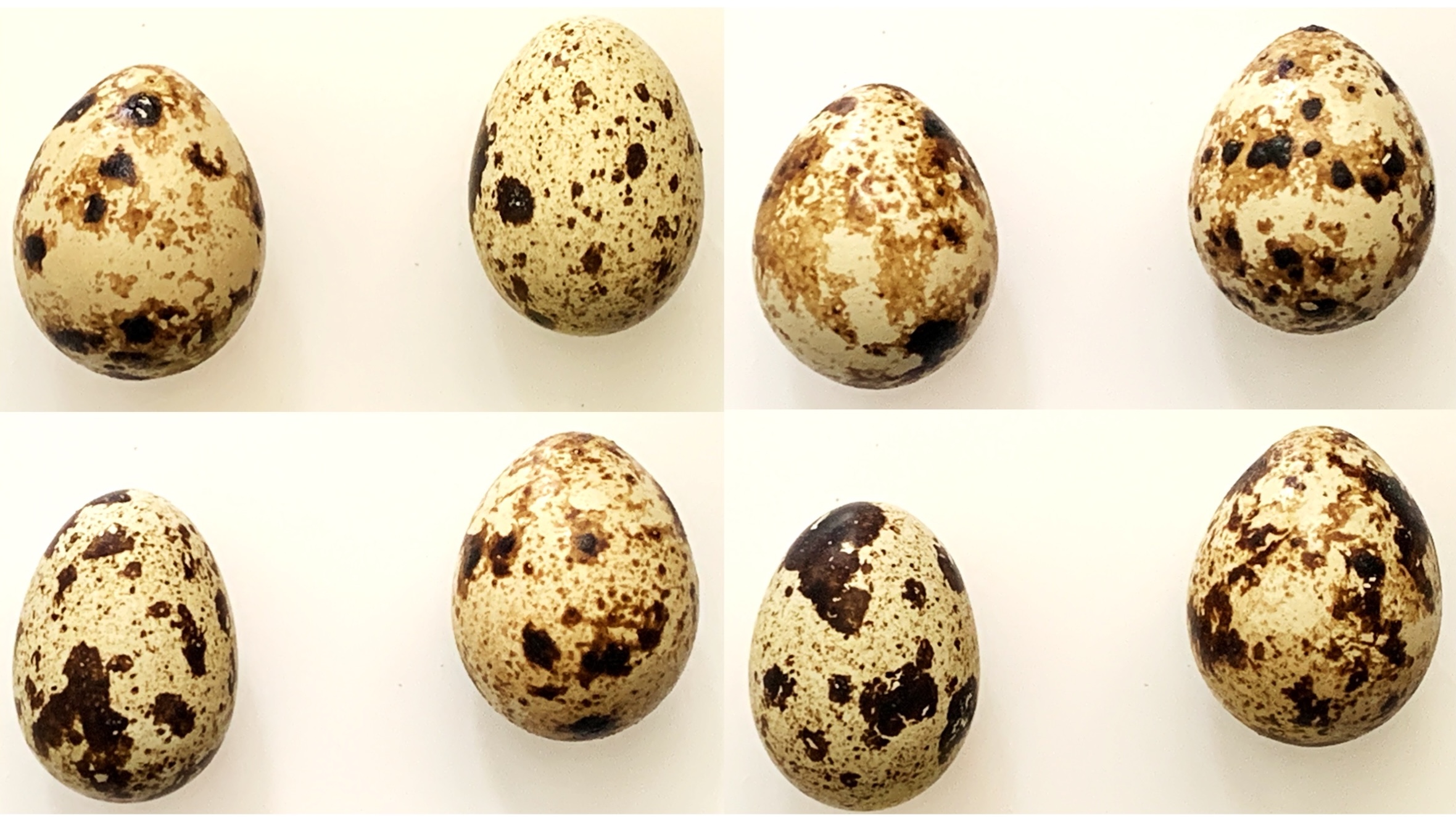
Easter 2026: The Patterns on Coturnix Egg

Last year, after a series of unsuccessful attempts and acquiring three incubators across two countries, my youngest son’s unwavering determination finally paid off.  From a batch of twelve mixed quail eggs, seven hatched successfully, marking the start of our new venture into farm animal husbandry.  Currently, we’ve settled for manageable pets like a Siberian hamster, an aquarium, and pond fish, plus several rounds of stick insects, mantises, and spiders, along with their grasshopper and locust food supplies.  However, quail care is more demanding. While our sons’ happiness is undoubtedly the most important reward, the delicious eggs produced by our farm breeding activity are equally rewarding for the whole family.  It’s particularly satisfying collecting every evening the two expected eggs from the punctual quail hens and admiring their different sizes and pigmentation like beautiful little gems.

If you’re still reading, you’ve probably guessed the main topics of my traditional Easter blog: quail eggs and their shapes and patterns.

Continue reading

RaPenduLa: Una Video piattaforma Fai-Da-Te Per Studiare Oscillazioni Meccaniche

Qualche giorno fa ho pubblicato un nuovo progetto educativo sul mio sito Instructables. Il dispositivo, che ho battezzato RaPenduLa (dalle iniziali in inglese di RaspPi Pendulum Laboratory), è stato ribattezzato in italiano CAMPO (Computer Analisi Moto Pendolare Oscillante) grazie a un suggerimento di ChatGPT. Ma, come direbbe Shakespeare, ‘What’s in a name? That which we call a rose by any other name would smell as sweet’: il cuore del progetto è infatti una piattaforma video per lo studio delle oscillazioni meccaniche. Utilizzando un Raspberry Pi Zero W2 dotato di modulo fotocamera, il sistema registra ad alta velocità il movimento dei pendoli. Poi, con un’analisi video basata su Python e OpenCV, RaPenduLa è in grado di tracciare il percorso preciso della punta del pendolo, visualizzandone il comportamento oscillatorio in 2D.

Continue reading

RaPenduLa: A DIY Video Platform for Exploring Mechanical Oscillations

I have recently published another educational project on my Instructables website. I called the device RaPenduLa for the RaspPi Pendulum Laboratory, and it is a video platform for studying mechanical oscillations. It uses a Raspberry Pi Zero W2 equipped with a camera module to record the motion of pendulums at high speed. The interesting part happens through video analysis: using Python and the fantastic OpenCV library, RaPenduLa can track the precise path of a pendulum’s tip and help visualize its oscillatory behavior in two dimensions.

Continue reading