My heart leaps up when I behold
A rainbow in the sky:
So was it when my life began;
So is it now I am a man;
So be it when I shall grow old,
Or let me die!
The Child is father of the Man;
And I could wish my days to be
Bound each to each by natural piety.William Wordsworth, March 26, 1802
I couldn’t resist citing the beautiful poetry by Wordsworth about the rainbow to introduce my new Instructable, ‘Explore the Physics of Soap Films with the SoapFilmScope.’ I got the idea for this project by reading an article by Gaulon et al. [1]. The authors describe in detail the use of soap film as an educational aid to explore interesting effects in the fluid dynamics of this system. In particular, they examine the impact of acoustic waves on the unique optical properties of the film. In this Instructable, we have designed a device called the SoapFilmScope to perform these experiments. This tutorial will guide you through the process of creating this device, showcasing the mesmerizing interaction between sound waves and liquid membranes. The SoapFilmScope offers an engaging way to explore the physics of acoustics, light interference, and fluid dynamics.
When a sound wave travels through the tube and vibrates the soap film, it creates dynamic patterns through several fascinating mechanisms:
The device consists of a vertical soap film delicately suspended at the end of a tube obtained from a PVC T-shaped fitting that you can get from any DIY store. By attaching a small inexpensive speaker to it, you can let the film dance to the rhythm of the music.
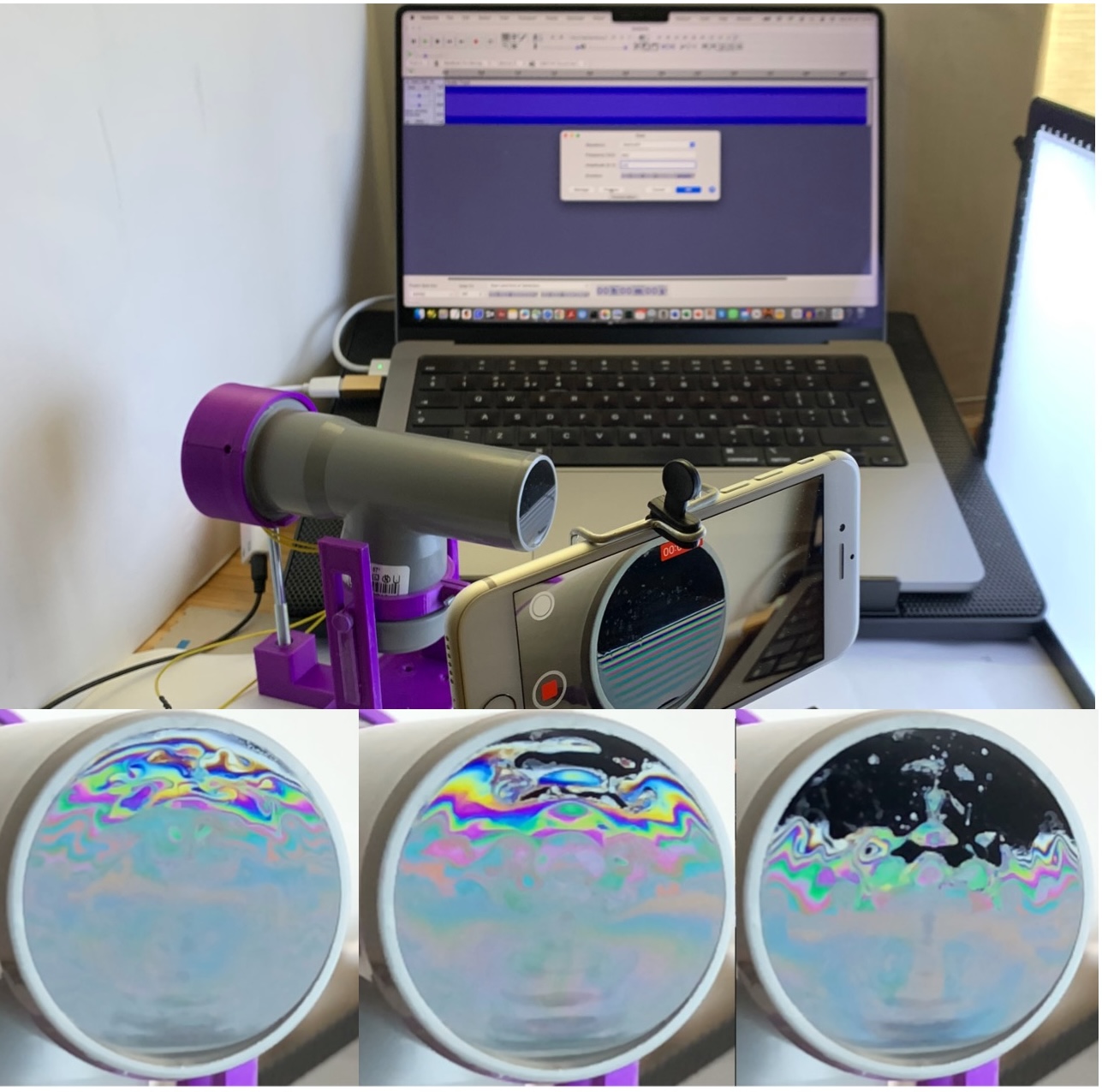
This is not just a vivid imagination, but a reality where colors swirl, split, and merge in synchrony with the music, thanks to the iridescence in the soap film. This captivating display is not only beautiful but also rich in physics.
- Acoustic Propagation: Sound waves travelling through the tube interact with the soap film, inducing capillary waves.
- Light Interference: Iridescence, caused by interference of light waves reflecting off the thin layers of the soap film, creates vibrant, shifting colours.
- Fluid Dynamics: The soap film responds to sound waves with both oscillatory and non-oscillatory flows, leading to vortex generation, complex diphasic patterns, and even film swelling under certain conditions.
These effects occur on various characteristic time scales, intricately linked to the timing of the music being played. By exploring these interactions, the SoapFilmScope not only serves as an artistic expression but also as an educational tool, making the science behind these phenomena accessible and engaging.
The article mentioned at the beginning, along with the references therein and classic books [2-4] on the subject, provide further information on the physics of soap films. Interested readers can consult these sources to gain a deeper understanding of the phenomena.
The Instructable, we will guide you through the steps to build your own SoapFilmScope. Specifically, we will cover how to:
- Construct the Device: Assemble the necessary components to create a setup where a soap film can be vibrated by sound waves.
- Experiment with Sound and Film: Use different sound frequencies and types of music to observe various patterns and effects in the soap film.
- Explore the Physics: Gain insights into the underlying physics, including acoustic propagation, light interference, and fluid dynamics, that produce mesmerizing effects.
I hope that this project inspires you to dive into the world of soap film physics and discover the beauty and complexity of this phenomenon. If so please recall also to add a Like to it, so I know that yhou liked it!
REFERENCES
- Gaulon, C., Derec, C., Combriat, T., Marmottant, P. and Elias, F., 2017. Sound and vision: visualization of music with a soap film. European Journal of Physics, 38(4), p.045804.
- Boys C V 1959 Soap Bubbles, their Colours and the Forces which Mould Them (New York: Dover)
- Lovett DR1994DemonstratingScienceWithSoapFilms(Bristol:InstituteofPhysicsPublishing)
- Isenberg C 1987 The Science of Soap Films and Soap Bubbles (Clevedon: Tieto) reprinted Isenberg C 1992 (New York: Dover)

 daniloroccatano.blog