Last year, after a series of unsuccessful attempts and acquiring three incubators across two countries, my youngest son’s unwavering determination finally paid off. From a batch of twelve mixed quail eggs, seven hatched successfully, marking the start of our new venture into farm animal husbandry. Currently, we’ve settled for manageable pets like a Siberian hamster, an aquarium, and pond fish, plus several rounds of stick insects, mantises, and spiders, along with their grasshopper and locust food supplies. However, quail care is more demanding. While our sons’ happiness is undoubtedly the most important reward, the delicious eggs produced by our farm breeding activity are equally rewarding for the whole family. It’s particularly satisfying collecting every evening the two expected eggs from the punctual quail hens and admiring their different sizes and pigmentation like beautiful little gems.
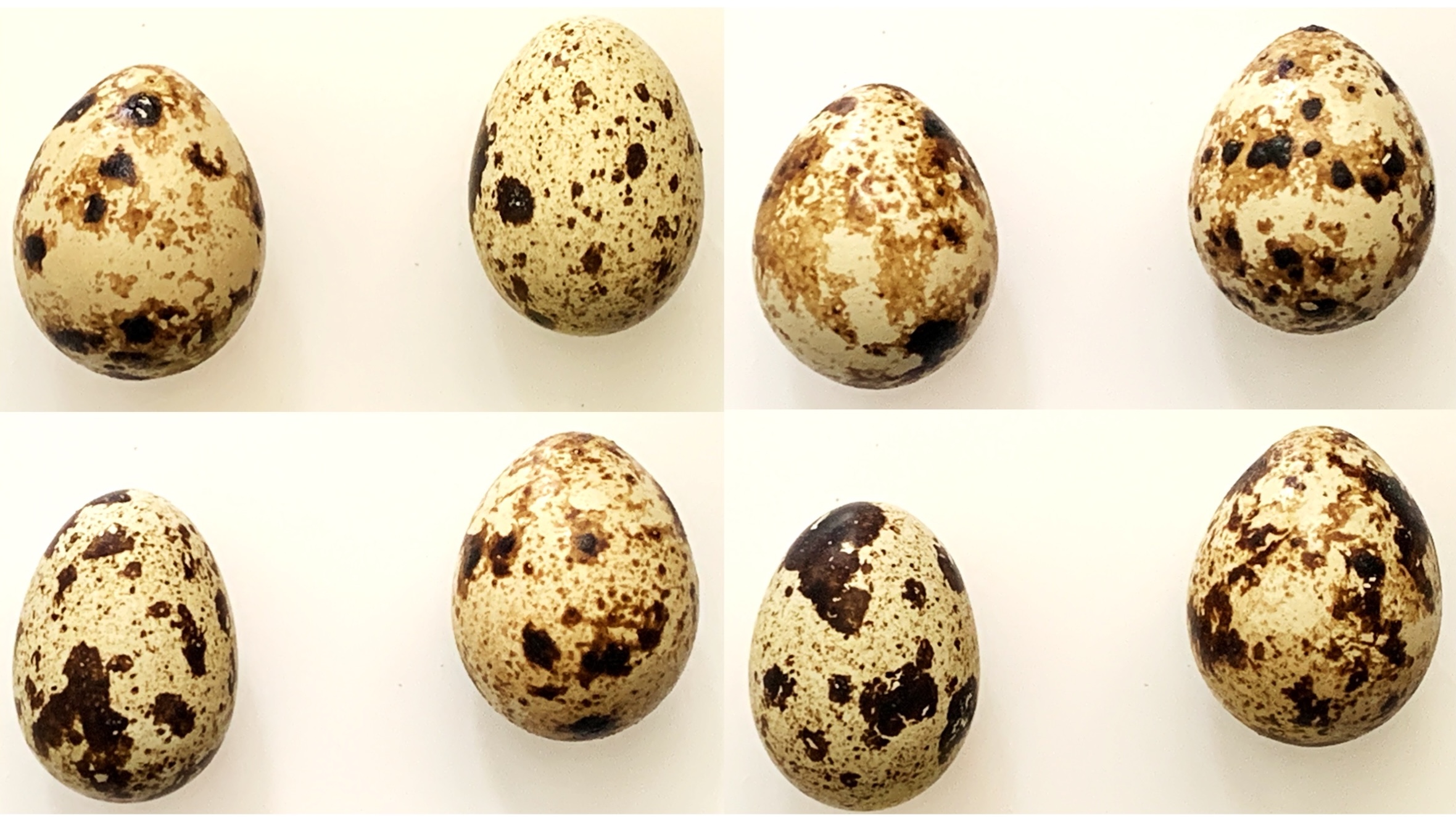
If you’re still reading, you’ve probably guessed the main topics of my traditional Easter blog: quail eggs and their shapes and patterns.
The shape of a Quail’s egg
Let’s begin with the shape of eggs. In my previous posts, I explored how egg shapes can be described using two-dimensional curve models, in particular, using the parametric formulation introduced by Frank W. Preston. These curves can then be revolved around their axis of symmetry to generate a full three-dimensional representation. I have used this approach to design and 3D print egg-shaped objects, as well as to explore shape transformations through simple computational programs.
Over the years, a number of mathematical models have been proposed to describe egg shapes. Most of these are parametric equations derived from different mathematical frameworks. While Preston’s model remains one of the most accurate and widely used descriptions, alternative approaches have also been developed. For example, D. E. Baker proposed a geometric method based on multiple measured parameters, offering a flexible—though more data-intensive—description of egg shape. Other formulations include geometric constructions such as the Hügelschäffer model, which provides a convenient representation of ovoid shapes and is often used in design applications. More recently, modern formulations developed by Valeriy G. Narushin and collaborators have introduced more general models capable of describing the full spectrum of egg shapes—from nearly spherical to highly asymmetric pyriform forms—using a reduced set of physically meaningful parameters.
In this article, we use the model developed by Baker (2002). The pipeline has been implemented in a Python program that reads the photo of the Coturnix egg from our quail and extracts the Baker equation parameters to generate a 3D representation. In the Baker formulation, the profile of the egg is described by the curve
![y(x) = T(1+x)^{\frac{\lambda}{1+\lambda}}(1-x)^{\frac{1}{1+\lambda}}, \qquad x \in [-1,1].](https://s0.wp.com/latex.php?latex=y%28x%29+%3D+T%281%2Bx%29%5E%7B%5Cfrac%7B%5Clambda%7D%7B1%2B%5Clambda%7D%7D%281-x%29%5E%7B%5Cfrac%7B1%7D%7B1%2B%5Clambda%7D%7D%2C+%5Cqquad+x+%5Cin+%5B-1%2C1%5D.&bg=ffffff&fg=444444&s=0&c=20201002)
This curve represents half of the egg’s cross-section. When revolved around its y-axis, it generates the full three-dimensional shape. The parameters 


Extracting the Shape from the Image
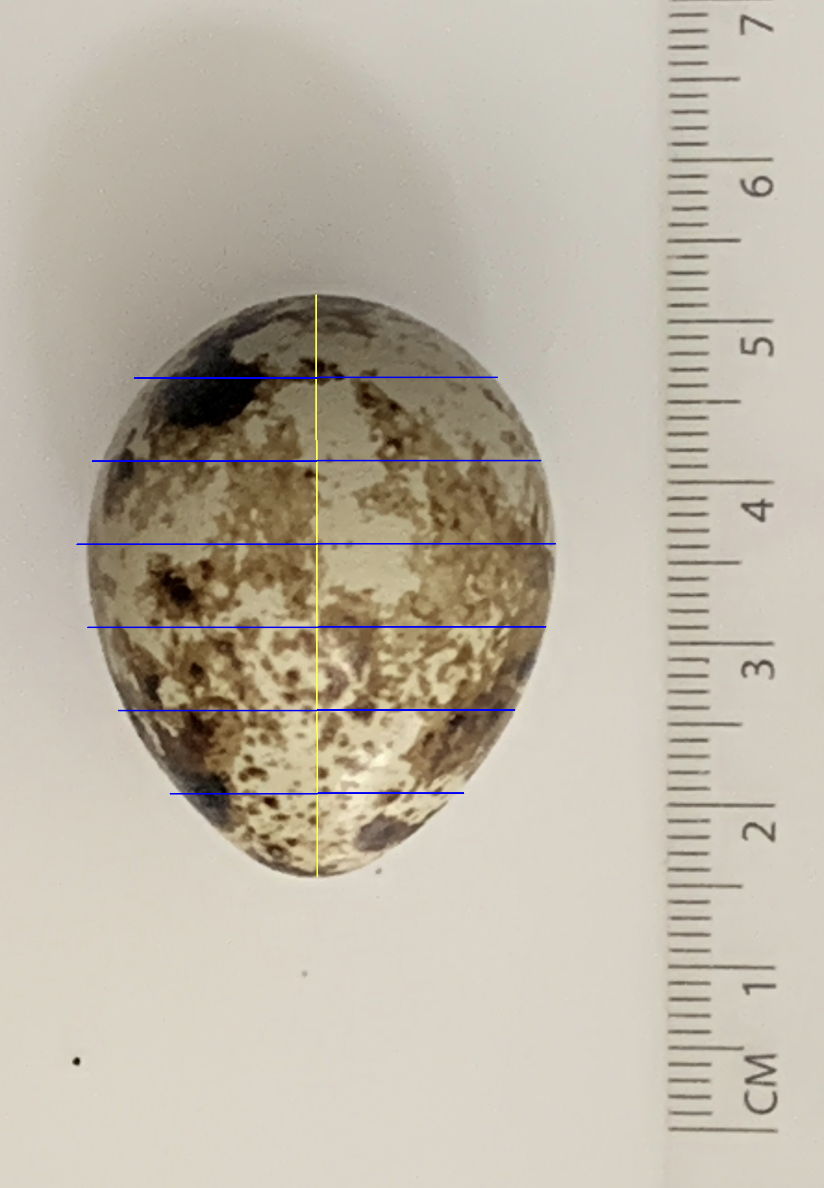
The key challenge is to determine these parameters from a real egg. The program approaches this by reducing the image to a one-dimensional geometric profile. The first step is the identification of the egg’s main axis. This is done interactively by selecting two points on the image, corresponding to the extremities of the egg. These points define a vector

which establishes both the orientation and the length 
![z \in [0,1]](https://s0.wp.com/latex.php?latex=z+%5Cin+%5B0%2C1%5D&bg=ffffff&fg=444444&s=0&c=20201002)

a line perpendicular to the axis is constructed. Along this direction, the image is scanned to detect the boundary of the egg. In practice, this is done either through intensity gradients or, more robustly, through a binary silhouette mask. The two intersection points define the local diameter 


![x \in [-1,1]](https://s0.wp.com/latex.php?latex=x+%5Cin+%5B-1%2C1%5D&bg=ffffff&fg=444444&s=0&c=20201002)
![z \in [0,1].](https://s0.wp.com/latex.php?latex=z+%5Cin+%5B0%2C1%5D.&bg=ffffff&fg=444444&s=0&c=20201002)
From Profile to 3D Surface
Once the function

where 
![\theta \in [0,2\pi]](https://s0.wp.com/latex.php?latex=%5Ctheta+%5Cin+%5B0%2C2%5Cpi%5D&bg=ffffff&fg=444444&s=0&c=20201002)
Modelling the Pigmentation: Reaction–Diffusion
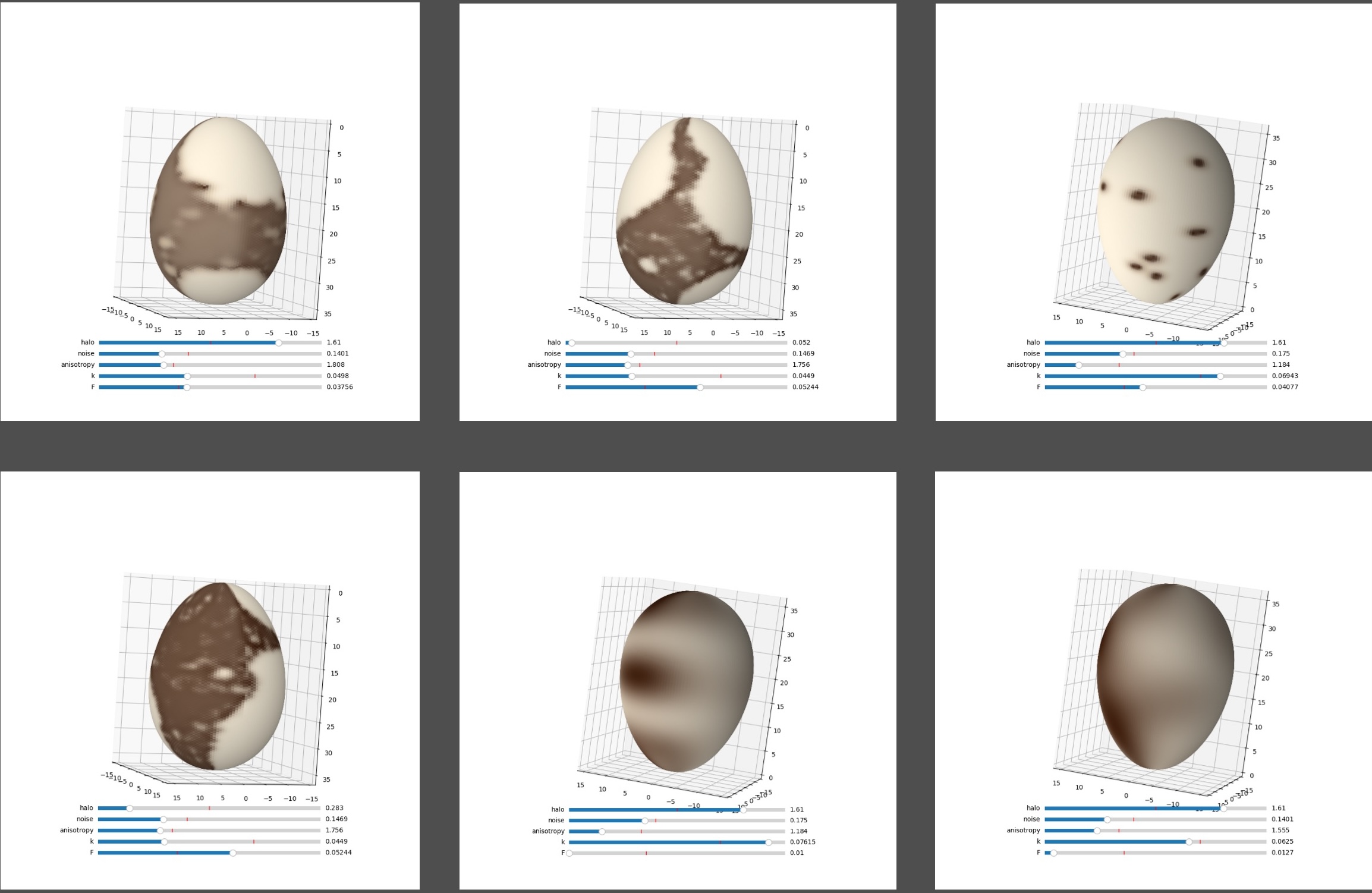
The visual richness of quail eggs, however, lies not only in their shape but also in their intricate pigmentation patterns. To reproduce and explore these patterns, the program incorporates a mathematical model based on reaction–diffusion systems, originally introduced by Alan Turing in his seminal 1952 paper on morphogenesis. In its simplest form, the model describes the interaction between two chemical species with concentrations u and v, evolving according to

where 


where 


From Model to Reality
Finally, the program brings together geometry and texture into a unified representation. The pigmentation pattern generated by the reaction–diffusion model is mapped onto the reconstructed surface, creating a visual link between mathematical form and biological appearance. A natural next step would be to analyse the real Coturnix egg patterns more quantitatively and attempt to reproduce them by tuning the parameters of the reaction–diffusion system. This would require a more careful projection of the observed texture, ensuring that only the visible surface of the egg contributes correctly to the mapped surface. However, this remains an exploratory direction for a future post. For now, the result is a synthesis of measurement and modelling: a mathematically defined shape, fitted to a real Coturnix egg, enriched with surface patterns that capture both its physical structure and its biological complexity.
I hope you have enjoyed this blog. If so, please consider liking and subscribing so you won’t miss future articles.
I wish you all a peaceful and joyful Easter holiday—and, perhaps more importantly, a moment of calm in these challenging times.
REFERENCE
- Frank W. Preston (1953)The shapes of birds’ eggs. The Auk, 70, 160–182.
- D. E. Baker (2002)A Geometric Method for Determining Shape of Bird Eggs.The Auk, 119(4), 1179–1186.
- Hügelschäffer model(cite via modern secondary sources if needed)
- Valeriy G. Narushin et al. (2020–2022)Universal formula for avian egg shape + related works
- Pearson, J.E., 1993. Complex patterns in a simple system. Science, 261(5118), pp.189-192.

 daniloroccatano.blog