"… I seem […] only like a boy playing on the sea-shore, and diverting myself in now and then finding a smoother pebble or a prettier shell than ordinary, whilst the great ocean of truth lay all undiscovered before me". – Isaac Newton.
AGGIORNAMENTO: Nel maggio 2025, il progetto ha ottenuto riconoscimento vincendo il 1° premio nel concorso Instructables All Things Pi. Un grande grazie al team di Instructables!
Qualche giorno fa ho pubblicato un nuovo progetto educativo sul mio sito Instructables. Il dispositivo, che ho battezzato RaPenduLa (dalle iniziali in inglese di RaspPi Pendulum Laboratory), è stato ribattezzato in italiano CAMPO (Computer Analisi Moto Pendolare Oscillante) grazie a un suggerimento di ChatGPT. Ma, come direbbe Shakespeare, ‘What’s in a name? That which we call a rose by any other name would smell as sweet’: il cuore del progetto è infatti una piattaforma video per lo studio delle oscillazioni meccaniche. Utilizzando un Raspberry Pi Zero W2 dotato di modulo fotocamera, il sistema registra ad alta velocità il movimento dei pendoli. Poi, con un’analisi video basata su Python e OpenCV, RaPenduLa è in grado di tracciare il percorso preciso della punta del pendolo, visualizzandone il comportamento oscillatorio in 2D.
UPDATE: In May 2025, the project achieved recognition by winning 1st prize in the Instructables contest All Things Pi. A big thank you to the Instructables teams!
I have recently published another educational project on my Instructables website. I called the device RaPenduLa for the RaspPi Pendulum Laboratory, and it is a video platform for studying mechanical oscillations. It uses a Raspberry Pi Zero W2 equipped with a camera module to record the motion of pendulums in high speed. The interesting part happens through video analysis: using Python and the fantastic OpenCV library, RaPenduLa can track the precise path of a pendulum’s tip and help visualize its oscillatory behavior in two dimensions.
It has become a recurrent habit for me to write a blog on the shape of eggs to wish you a Happy Easter. Not repeating oneself and finding a new interesting topic is a brainstorming exercise of lateral thinking and a systematic search in literature to find an interesting connection. This year, I wanted to explore an idea that has been lurching in my mind for some time for other reasons: billiards.
I used to play snooker from time to time with some old friends. I am a far cry from being even an amateur in the billiard games, but I had a lot of fun verifying the laws of mechanics on a green table. I soon discovered that studying the dynamics of bouncing collision of an ideal cue ball in billiards of different shapes keeps brilliant mathematicians and physicists engaged in recreational academic studies and important theoretical implications.
Today, I was pleasantly surprised by a message from WordPress. It announced that a very generous reader had gifted a subscription. This gift covers the cost of my personal plan and website domain.
First and foremost, I want to express my heartfelt thanks to this undisclosed reader for their generosity. You are the first to make such a donation. Your support has given me a great boost of encouragement to continue writing. If you wish, I would be happy to acknowledge you on this page.
This blog began as a personal space to share my work as an educator and scientist. Over time, it has also become a place for reflections on my past experiences and long-standing hobbies. I enjoy exploring a wide range of scientific topics that spark my curiosity, and I write simply for the joy of sharing my enthusiasm for science. My endless curiosity drives my fascination with the natural world and the universe around us. I started this journey with no particular expectations—just personal fulfillment. Now, I’m delighted to see the readership growing and grateful that some of you find this blog valuable enough to support it.
***THANK YOU***
I have written this post in English. I do not know the donor’s primary language. This ensures my gratitude reaches you. If English is not your main language, inform me. I am happy to express my thanks in Italian or German. Spero tuttavia che il mio messaggio sia chiaro anche ai tanti connazionali che leggono le mie pagine in italiano o ai lettori di lingue latine che possono comprenderlo, e li ringrazio di cuore.
Und ich hoffe auch, dass viele deutschsprachige Leser meine Seiten auf Deutsch verstehen können – so gut es geht! 😊
As the year comes to a close, let us take a moment to reflect on the beauty of nature and the profound patterns that can arise from simple rules. Inspired by the Diffusion-Limited Aggregation (DLA) simulation—a concept that creates mesmerizing structures from chaotic randomness—we find parallels between its patterns and the essence of the holiday season.
The animation featured here was created using my DLA simulator, written in Awk, my favorite programming language. This program simulates the deposition of randomly diffusing particles in two dimensions. In this case, it mimics the formation of snowflakes or coriander-like clusters, with particles meandering through randomness to form intricate fractal structures.
These patterns remind us how small, individual efforts can come together to create something extraordinary. Be it family gatherings, acts of kindness, or moments of generosity, each step contributes to a larger, beautiful picture—much like how particles aggregate to form stunning natural structures such as snowflakes, coral reefs, or mineral deposits.
Wishing You:
🎄 Fractal Joy: Let your happiness grow in beautiful and unexpected ways.
🌟 Boundless Creativity: Like the Moore and von Neumann neighborhoods in the simulation, embrace different perspectives to expand your horizons.
❄️ Peace and Harmony: May your life’s matrix be filled with meaningful connections and serene moments.
May your holidays be filled with love, joy, and wonder — and may your 2024 be as inspiring as the intricate patterns of life itself!
My heart leaps up when I behold A rainbow in the sky: So was it when my life began; So is it now I am a man; So be it when I shall grow old, Or let me die! The Child is father of the Man; And I could wish my days to be Bound each to each by natural piety.
William Wordsworth, March 26, 1802
I couldn’t resist citing the beautiful poetry by Wordsworth about the rainbow to introduce my new Instructable, ‘Explore the Physics of Soap Films with the SoapFilmScope.’ I got the idea for this project by reading an article by Gaulon et al. [1]. The authors describe in detail the use of soap film as an educational aid to explore interesting effects in the fluid dynamics of this system. In particular, they examine the impact of acoustic waves on the unique optical properties of the film. In this Instructable, we have designed a device called the SoapFilmScope to perform these experiments. This tutorial will guide you through the process of creating this device, showcasing the mesmerizing interaction between sound waves and liquid membranes. The SoapFilmScope offers an engaging way to explore the physics of acoustics, light interference, and fluid dynamics.
When a sound wave travels through the tube and vibrates the soap film, it creates dynamic patterns through several fascinating mechanisms:
The device consists of a vertical soap film delicately suspended at the end of a tube obtained from a PVC T-shaped fitting that you can get from any DIY store. By attaching a small inexpensive speaker to it, you can let the film dance to the rhythm of the music.
Henk Rogers: Um, I like Pascal. Assembler is my go-to. But never underestimate… Alexey Pajitnov: …the power of BASIC.
From the movie Tetris (2023).
It has been a long while that I wanted to write this article. The usual motivation is to propose another of my BASIC programming explorations performed in the 80s on my Philips MSX VG-8010 and Amiga 500 microcomputer. The exploration was encouraged by the reading of another of the brilliant articles by A. K. Dewdney in his column “Ricreazioni al Calcolatore” (Computer Recreation) of Le Scienze, the edition in Italian of Scientific American [1]. Dewdney’s article was inspired by the beautiful book by Thomas F. Banchoff [2] who pioneered in the early 1990s the study using computer graphics of hyperdimensional objects.
Oh my God. Do you know what this is? This is a dinosaur egg. The dinosaurs are breeding.
Dr. Alan Grant, Jurassic Park movie (1993)
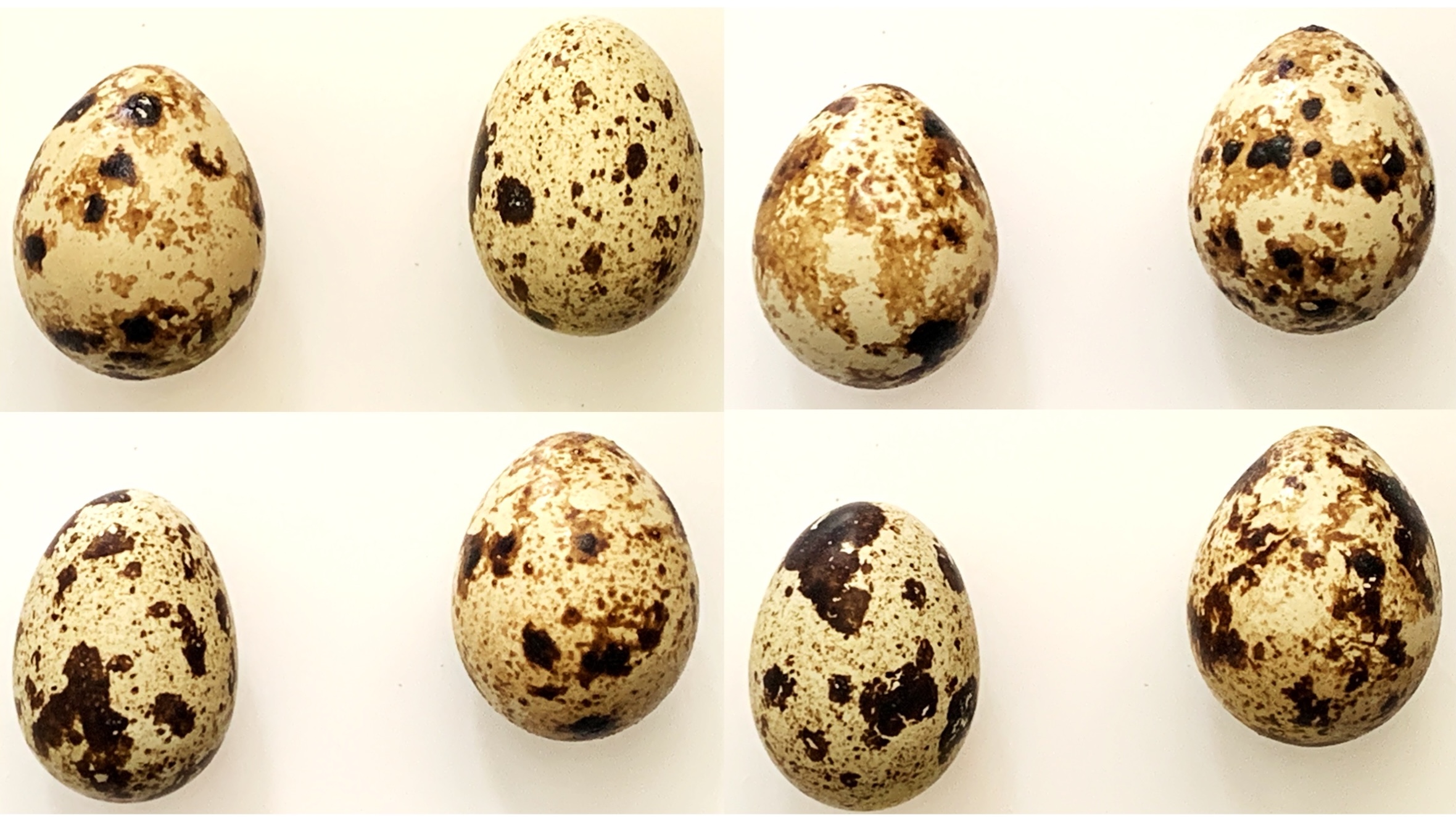
We are again approaching Easter time and, as tradition, I would like to celebrate with an article dedicated to the most perfect thing in nature: the egg. I came across interesting books about the discovery of dinosaur eggs last year. Dinosaurs are the ancestors of birds and modern reptiles, so we will take a little detour from the traditional Easter egg, and with the spirit of equal opportunity justice, we will look at the shape of these.
Sometime ago, I have written about the Lissajous-Bowditch figures. In the same article, it is described how to build a simple device called a kaleidophone to generate Lissajous patterns. Using a small mirror fixed securely to the end of a bent wire on a stable platform and a laser beam from a laser pointer reflects off it, mesmerizing, intertwined spirals of light. The laser beam will appear dancing on the wall of your room. This enchanting display results from two mutually perpendicular harmonic oscillations generated by the vibrations of the elastic wire. These captivating patterns are known as Lissajous-Bowditch figures and are named after the French physicist Jules Antoine Lissajous, who did a detailed study of them (published in his Mémoire sur l’étude optique des mouvements vibratoires, 1857). The American mathematician Nathaniel Bowditch (1773 – 1838) conducted earlier and independent studies on the same curves, and for this reason, the figures are also called Lissajous-Bowditch curves [2].
LB curves result from the combination of two harmonic motions, and therefore, they can be mathematically generated through a parametric representation involving two sinusoidal functions (see Figure and also here). Lissajous invented different mechanical devices reproducing these periodic oscillations consisting of two mirrors attached to two oriented diapasons (or other oscillators) by double reflecting a collimated ray of light on a screen, producing these figures upon oscillations of the diapasons. The diapason can be substituted with elastic wires, speakers, pendulum, or electronic circuits. In the last case, the light is the electron beam of a cathodic tube (or its digital equivalent) of an oscilloscope [3].
The simplest of these devices is the KaleidoPhone, invented (and named) by the British physicist Charles Wheatstone at the beginning of the 19th century [3,4]. The Kaleidophone creates stunning Lissajous patterns and is an excellent example of how science can also be an art form. You can bring the mesmerizing dance of light to life with just a few simple materials and creativity.
In a new Instructable project, I have presented a modern compact version of the kalidophone device fabricated with the help of 3D printing technology and enhanced with a digital camera.
For this last bit of modern technology, the new device is called KaleidoPhoneScope. What makes this little device is the facility to adapt it to record another form of vibrations by adding a speaker and another mirror free to vibrate on its bizarre pattern, recalling SciFi movies promp appear on a free wall (or door) of your studio.
As Christmas approaches, what is the best time to try this device with a traditional song? Here is the result. Activate the captions to see the corresponding frequencies of the tones.
I wish you all to spend a Merry Christmas with your dearest, and I hope to see a peace and
REFERENCES
T. B. Greenslade Jr., “All about Lissajous figures,” The Physics Teacher, 31, 364 (1993).
T. B. Greenslade Jr., “Devices to Illustrate Lissajous Figures,” *The Physics Teacher, 41, 351 (2003).
C. Wheatstone, Description of the kaleidophone, or phonic kaleidoscope: A new philosophical toy, for the illustration of several interesting and amusing acoustical and optical phenomena, Quarterly Journal of Science, Literature and Art 23, 344 (1827).
R. J. Whitaker, “The Wheatstone kaleidophone,” American Journal of Physics, 61, 722 (1993).
The electronegativity of a chemical element measures the tendency of an atom to attract electrons around it. This definition was formalized for the first time, in a semi-empirical form, by the chemist Linus Pauling in the early 1930s, but it had already been proposed in the late 1800s by the Swedish chemist Berzelius. In molecules, this tendency determines the molecular electronic distribution and therefore influences molecular properties such as the distribution of partial charges and chemical reactivity. Pauling provided an electronegativity scale by comparing bond dissociation energies of pairs of atoms (A, B) using the equation
With $E_{AB}$, $E_{AA}$, and $E_{BB}$ being the dissociation energies of the molecules AB, AA, and BB, respectively.
A few years later, in 1934, Mulliken proposed an expanded definition of electronegativity based on spectroscopically measurable atomic properties such as ionization potential (I) and electron affinity (E):